Kenneth Copeland’s False Teaching of Jesus Being Born Again in Hell, and His Misunderstanding of Jesus’s Authority.

by Lisa Groen

I am writing this article to show plainly that Kenneth Copeland on his website is teaching the idea that Jesus was born again in hell, and the ridiculousness of this idea, and why this idea is a false teaching, and Copeland’s misunderstanding of Jesus’s authority.

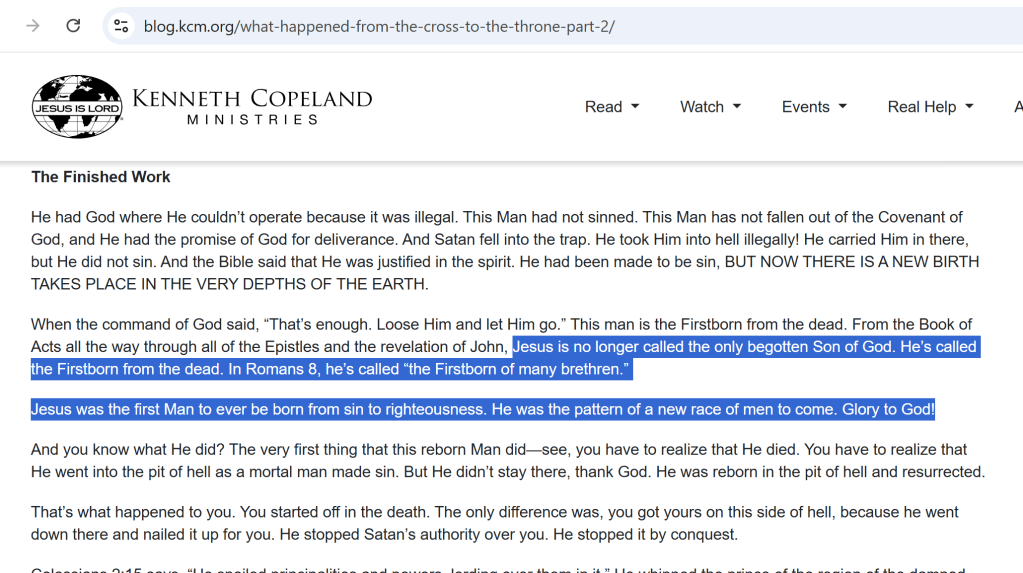
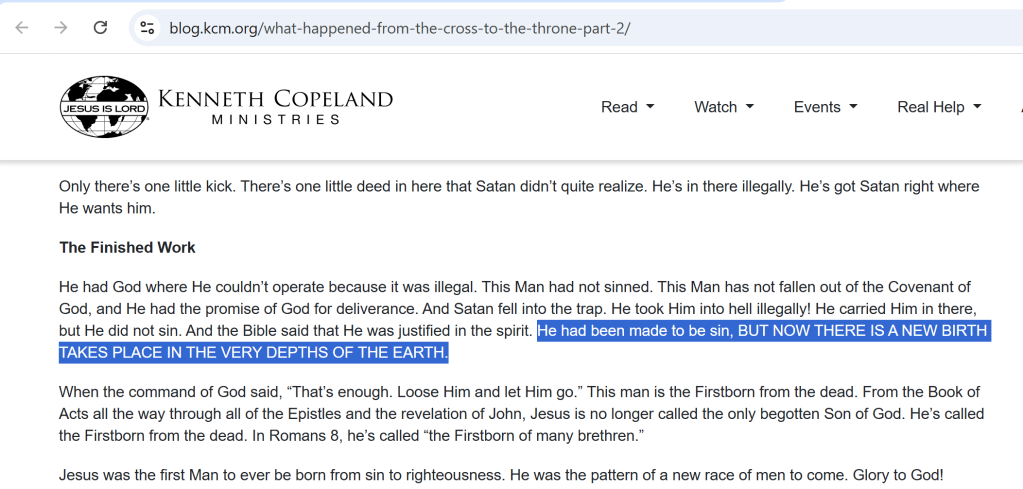
I am basing this blog post on Kenneth Copeland’s online article entitled “What Happened From The Cross To The Throne Part 2” I will share screenshots to document the false teachings in his article. This screenshot below was taken near the heading entitled “The Finished Work”. Note the highlighted areas:

Copeland above says that Jesus went to hell and was born again there. This is absurd because being born again was something God provided as a rescue for mortal sinners who need forgiveness, that would give them new spiritual life with God. Jesus was never a sinner and he did not need to be forgiven, and he already had spiritual life with God. Jesus did not need the kind of salvation that God provided as a ransom for sinners. Jesus WAS the ransom. Jesus IS salvation. Let’s look at the next highlighted area in the screenshot below.

Copeland says Jesus is no longer called the only begotten Son of God from the book of Acts to John’s Revelation, but He’s called the Firstborn from the dead. Copelands definition of these two phrases are very different that what the Bible teaches. Copeland seems to say “Jesus was born again, and that he needed to be born again in order to be the leader of all Christians who need to be born again, so he could be the Firstborn of many brethren.” But the logic doesn’t follow. A Shepherd doesn’t have to become a sheep to lead the way for the sheep to be saved from danger. A Shepherd just leads them and is way above them in many ways, such as knowledge, common sense, ability and strength. A shepherd doesn’t have to eat grass to show his sheep how to keep from starving. Again the shepherd is way above the sheep but Jesus made the sheep to be drawn to eat when he created them. Jesus saves us not by being born-again himself, but by drawing us to believe in him and be saved. He stays way above us and doesn’t need to be born again to be the Firstborn of many brethren. Because He is GOD.

But Copeland says that the meaning of Jesus being begotten means Jesus was born again, but what it means Biblically is that there was only ONE conception like the conception of Jesus. That was when the Holy Spirit overshadowed Mary and God placed physical DNA inside of Mary, the physical material that would become Jesus’s body, and God placed the Soul and Spirit of Jesus in union with his body so that he would grow up in Mary’s womb. and become the God-man, God from God, Light from Light. Because believers in Jesus are “born from the dead”, Copeland conflates this in his thinking to mean Jesus and born again people are on the same playing field. The Bible teaches believers are born-again, from a place of deadness to God, and made alive to God, but we are not “God from God, Light from Light” as Jesus was. The believer retains many of his or her personality traits and cognitive and physical abilities after he or she becomes born again as they had before they were born again. We don’t give up our personalities to become saved. We are made in the image of God, but retain many of our traits, but what is new, is that we receive the spiritual fruit of Galatians 5, and other communicable attributes of Jesus, but we are not on the same playing field as Jesus in his incommunicable attributes. We are saved from the bondage to sin, and delivered out of the kingdom of darkness, where now Jesus is our new King in the Kingdom of Light. Jesus is way HIGH above us. But Copeland is demoting Jesus and making him as common as a born again person:

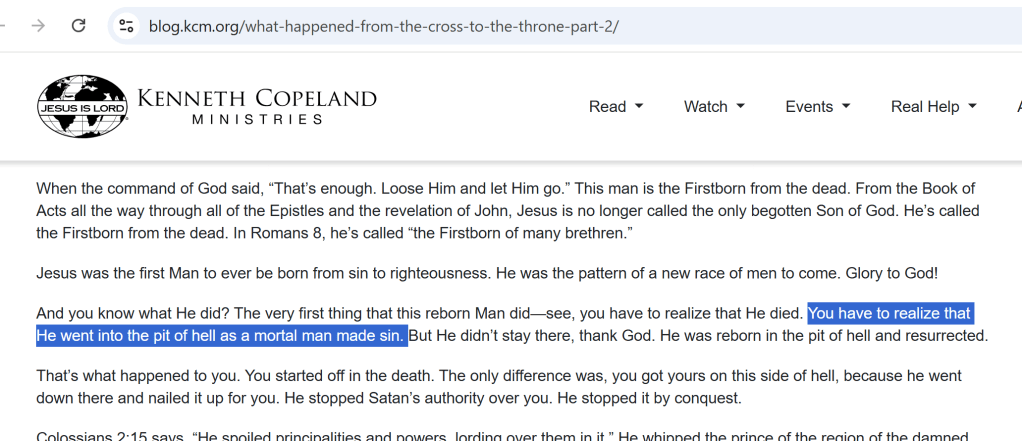
and again:

He said Jesus was just a mortal man made sin. But Jesus was the God-man, not JUST a man. The phrase Jesus “was made to be sin”, many scholars believe that it is the short way of saying Jesus became the sin offering, and that Jews of Jesus’ time would shorten the phrase “the sin offering” to “sin”. So if we plug that phrase into 2 Corinthians 5:21, it would say “For our sake he made him to be (the) sin (offering) who knew no sin, so that in him we might become the righteousness of God.” ESV parentheses mine.

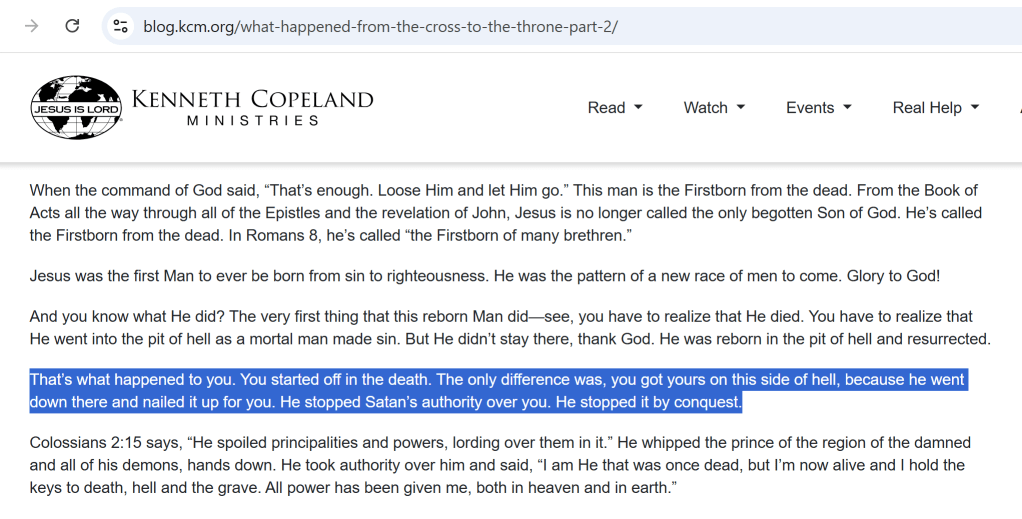
Copeland believes there are similarities between Jesus’s resurrection and the believer’s resurrection. The Bible does too. But Copeland makes up similarities between the believer and Jesus that don’t exist. Note the words below, “…the only difference…”:

When Copeland says “the only difference was, you got yours on this side of hell” I believe he is talking about the resurrection. The believers were raised up from spiritual death when they are born again on this side of heaven. True, but Copeland’s statement that Jesus went to the very pit of hell and “nailed it up for you. He stopped Satan’s authority over you. He stopped it by conquest” has tremendous problems. Copeland is talking about a conquest in hell between Satan and Jesus that we can safely say Copeland imagined, because it is no were in the Bible. In the Bible Jesus paid our sin debt in full on the cross, and then he said “it is finished” before he died. Jesus was awarded resurrection because the full wrath of God had been exhausted upon him and paid for. The righteous wrath of God had been poured out on Jesus and was satisfied, so, there was no punishment for Jesus left nor for those who would believe upon Him for him to have to go to the very PIT of hell. After Jesus died, he could go to paradise and lead captivity captive specifically because of the victory of the cross. This was the place of Abraham’s bosom. This was the place where the righteous saints who died before the resurrection of Jesus would go. So there was no conquest between Jesus and Satan in the PIT of hell.

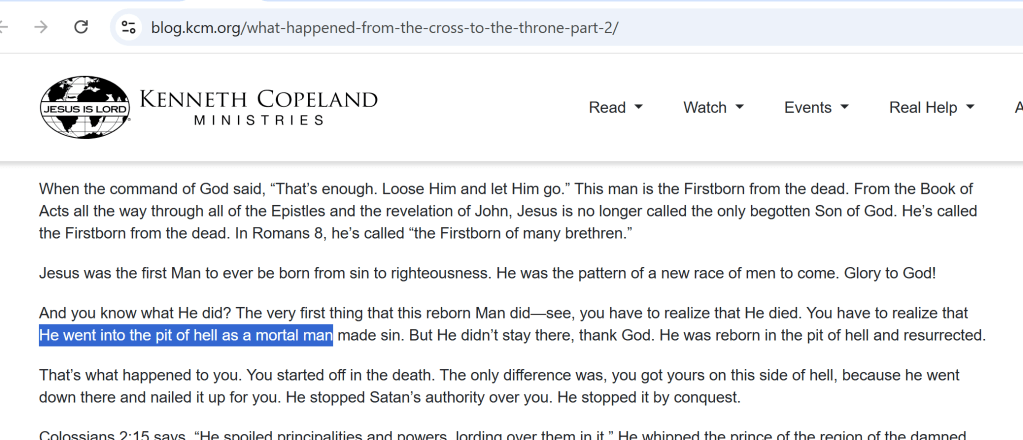
The pit of hell would be a place of suffering and torment for those punished by God. God was the one who punished Jesus in our place on the cross. Jesus didn’t go as someone’s prisoner when he died, because “death could not hold him”, and Satan by that point was defeated, so he didn’t go to the pit of hell, but to Abraham’s bosom, or Sheol to lead captivity captive. And when he went and took captivity captive, he certainly wasn’t kept in the pit of hell by Satan, or by God but Jesus had full authority over himself after he died because he had full authority over himself while he lived each day of his life. He never gave Satan a foothold. Satan had no hold on him, and the very pit of Hell was only for those who live in sin and refuse to follow God. Jesus was successful in paying for our sins before he died. He said “It is finished, then breathed his last.” Copeland has nullified the power of the Cross:

The conquest Jesus won, was on the cross, by humbling himself, dying in our place, and taking our sins upon himself and bearing them away as the sinless lamb of God. There was no conquest between Jesus and Satan after he died because while he was on the earth, there was no physical conquest between Jesus and Satan on the earth. Satan also couldn’t lie to Jesus and be successful. Jesus just spoke the truth and resisted Satan. And Satan fled. When Jesus was crucified it was God’s plan to save the lost. Here is the victory Jesus had on earth in never sinning. Jesus’s authority over himself was in tact all the time and that was how he won the conquest against Satan:

John 8:46: “Which of you convicts me of sin? And if I tell the truth, why do you not believe Me?” (NKJV). 

2 Corinthians 5:21: “For He made Him who knew no sin to be sin for us, that we might become the righteousness of God in Him” (NKJV). 

1 Peter 2:22: “Who committed no sin, nor was deceit found in His mouth” (NKJV). 

1 John 3:5: “And you know that He was manifested to take away our sins, and in Him there is no sin” (NKJV). 

Hebrews 4:15: “For we do not have a High Priest who cannot sympathize with our weaknesses, but was in all points tempted as we are, yet without sin” (NKJV). 

In the shot above after the Colossians scripture Copeland writes that Jesus took authority over Satan and said “I am He that was once dead, but I’m now alive and I hold the keys to death, hell and the grave. All power has been given me, both in heaven and in earth.” Those are 2 scriptures from Revelation 1:18, and Matthew 28:18. But Revelation gives no proof or indication that this happened when Jesus was between the cross and the throne, nor that these scriptures were spoken one after the other, nor that Jesus spoke them to Satan. Rather, when the wrath of God was paid in full, and Jesus said it is finished, Jesus went to the place of the dead to cause several old testament saints to rise with him when he would rise from the dead. There is no evidence in the Bible that Jesus spoke to Satan between the cross and the throne. Rather, the evidence seems to point to the opposite because on the cross Jesus said “It is finished”, and these words signify that he spoiled the principalities and powers by the cross. Colossians 2:15 And having disarmed the powers and authorities, he made a public spectacle of them, triumphing over them by the cross.” The Devil was not in charge of anything anymore because the atonement was paid in full, and Jesus broke the power of death, hell, and the grave, but did this on the cross, not in hell.

Was it not the sheer righteousness Jesus offered, and shed blood and what he suffered on the cross with the full wrath of God being poured out on him in the atonement and those things together were indeed the fullness of all authority to clear the sinner of sin, when Jesus said the words “It is finished”? Those 3 words were spoken after the wrath of God was poured on him to signify to us no more atonement needed to be paid. Jesus had no need for a conquest or words with the devil–the atonement was God’s business, not the devil’s, and the resurrection was God’s business demonstrating Jesus’s full authority was unstained, in tact and I believe unchallenged between the cross and the throne. *LG

Does Salvation Require Repentance?

Salvation does not require repentance, but it produces repentance.

According to Wayne Grudem, in his book Systematic Theology, An Introduction to Biblical Doctrine, on page 699 we find him explaining that regeneration happens before conversion happens (conversion defined by faith and repentance). Regeneration is a work done completely by God, and initiated by God. Faith and repentance come usually hand in hand, and repentance and faith are enabled to happen by God and somehow allowing our participation, causing us to be willing to use our faith and willing to repent, and prompting us toward these actions.

We could ask, “How simple can salvation be and it still counts as salvation?” A person’s salvation could be as simple as was the salvation of the thief on the cross, who lived just minutes or hours in a state of salvation.

Romans 10:13 reads, “for, “Everyone who calls on the name of the Lord will be saved.”

This is quite simple. But is it simply repeating something out of your mouth? Is it that all God is requiring is that we should repeat a phrase amounting to “Save me Lord Jesus” like a robot and that’s all that would be needed to save someone? Surely Romans 10:13 means more than mouthing a prayer like a robot to appease God.

The Bible makes reference to the idea that what goes on in the heart is paramount to what matters to God in the process of prayer or in the process of saving someone. I am not saying that we need to make the act of calling on God more difficult than it needs to be, but I am saying calling on the name of the Lord in the Biblical sense should mean at least to be sincere in your calling on the name of the Lord.

We could imagine a child who cries crocodile tears to avoid punishment after getting caught doing something wrong. We can imagine a person who simply says words to a beautiful woman with a hope to “say what she wants to hear” simply in order to manipulate her. Or we could imagine a person who pretends to like a food coked a certain way in a meal not because he genuinely liked it but simply to humor the chef to stay on his good side.

How does the Bible mention the need for sincerity in praying for salvation?

Psalm 145:18 The Lord is near to all who call on Him,
To all who call on Him in truth.
19 He will fulfill the desire of those who fear Him;
He will also hear their cry for help and save them.

It says if you call on Him in truth, the Lord is near you. If we look up Romans 10:13 in the Greek, on Biblehub.com, it says the phrase “shall call upon” has some interesting traits. About halfway down the page of https://biblehub.com/greek/1941.htm in the lexicon section we get this explanation:

5. Hebraistically (like יְהוָה בְּשֵׁם קָרָא to call upon by pronouncing the name of Jehovah, Genesis 4:26Genesis 12:82 Kings 5:11, etc.; cf. Gesenius, Thesaurus, p. 1231{b} (or his Hebrew Lexicon, under the word קָרָא); an expression finding its explanation in the fact that prayers addressed to God ordinarily began with an invocation of the divine name: Psalm 3:2Psalm 6:2Psalm 7:2, etc.) ἐπικαλοῦμαι τό ὄνομα τοῦ κυρίου, I call upon (on my behalf) the name of the Lord, i. e. to invoke, adore, worship, the Lord, i. e. Christ: Acts 2:21 (from Joel 2:32 ()); ; Romans 10:131 Corinthians 1:2…”

Near the end of the quote we get the words, “I call upon (on my behalf) the name of the Lord, i. e. to invoke, adore, worship, the Lord…Romans 10:13.” This is saying the way calling on the Lord happens in Romans 10:13 involves invocation, adoration, or worship of the Lord. So when this calling on the name of the Lord happens, intrinsic within the calling, is a directional repentance that is distinguishable from a prior direction of sin, because in order to invoke, adore or worship the Lord, one must have turned or at least be in the process of turning from sin in order for that calling on the name of the Lord to be sincere, which is the root meaning of Romans 10:13.

Now if you are sincerely calling on the Name of the Lord, you must have some understanding that the Lord is higher and more powerful than you are, to save you, and the result is, if you are sincere, you shall be saved.

It may be hard to distinguish from the Bible what millisecond a repentance happens after faith is operating. But I think it is right to understand that calling on the Lord in truth as Psalm 145:18 also seems to intrinsically to involve a turning from sin or evil, which is repentance in its initial stage. We realize that in ourselves we have no power to save ourselves, and in turning to God, if we are going to seek him in a truthful way, we can believe he is in the opposite direction from our sin, or from the evil we find ourselves stuck in at times, and by calling on him the very act of turning to the Lord is in fact a turning from sin and evil, (repentance) although a beginning repentance, but the Bible says that is in fact sufficient to save someone. (Romans 10:13) After justification happens for the believer, the Lord continues the work of salvation through refining us with more repentance and the sanctification process. LG

Why Does God’s Plan Of Salvation Not Include Any Help From The Believer?

By Lisa Groen

The truth is all of us have sinned. We’ve all fallen short of the glory of God. (Romans 3:23)

I don’t mean God isn’t interested in our obedience, because He is! (Romans 1:5) But He must save us first before we can have the kind of obedience he is looking for! (2 Timothy 1:9, Galatians 3:6-9) When God begins with us, we deserve God’s wrath for eternity because it’s about who we’ve sinned against. Why is sin so serious? –because of who we’ve sinned against. The greater the person to whom a wrong is done, the greater the wrong that is done. It’s ultimately against God that we’ve sinned. Every sin we commit is against God in the least sense and against two or more persons in the broadest sense.

God cannot and does not need our efforts to save us because Jesus said it is finished. (John 19:30) It would go against God’s aseity if salvation were dependent on us, (Psalm 3:8) and if it’s against His aseity, it’s against his nature. (Isaiah 45:5, Psalm 86:10) And it would go against what Jesus said if it were not finished but was dependent on us. And that would make Jesus a liar, and he is not! That would make him not Lord but he is Lord! (1 Corinthians 8:6, John 20:28)

If he needed us to do part of the work of our own salvation, and we sometimes err, that means I will or could potentially mess up if it were dependent on me, because erring is the very reason we need salvation. (Romans 3:23) And if my salvation depended on myself, and not God, that potential for error could or would somehow get translated into the work of salvation in my life IF the work of salvation was somehow my work. (Ecclesiastes 7:20, John 3:19) But it’s NOT, it’s God’s work in spite of our work, (Isaiah 57:18) it’s God’s work in place of our work, (Genesis 15:12-21) his work in times of us bewildered because of our failure, (Job 42:6) it’s God’s work in exchange for our work, (2 Corinthians 5:21) it’s God’s work because we don’t have the capacity to work it out left to ourselves, (Romans 5:6) it’s God’s work and him taking the initiative because He sees our work is broken.(Genesis 3:21) It’s God working and us resting in him, Him doing and us trusting, because his work is everlasting (Jeremiah 31:3, Isaiah 41:28) and even when we feel frozen, (Psalm 46:10) or pausing because of our loud weaknesses, (Matthew 26:75) it’s God’s strength made perfect in our weakness (2 Corinthians 12:9).

The act of him making us born again is his work 100%. (Isaiah 43:11, Hosea 13:4) That saves us from having to produce the work of making us holy. He will make us holy and he’ll do it by using our obedience (Leviticus 20:8) but not because he is short on obedience but uses ours to shape us. (2 Corinthians 3:18, Romans 8:29). So He is totally in control of the work of saving and sanctifying us. He began the good work and He will finish it.(Philippians 1:6) He is the author and perfector of our faith. (Hebrews 12:2) He is the birther of our walk of service to God, (Exodus 23:25) the designer of it, the upholder of our salvation, (Isaiah 41:13) the producer of it, (1 John 5:4-12) the continuer or it (John 8:31-32) and the founder and completer (Hebrews 11:10, 12:25-29) of the life given by God (1 Corinthians 3:11)

It has to be his work, or it cannot be pure; (2 Samuel 22:7, Habakkuk 1:13) it must be his work or it’s not trustworthy; (Psalm13:5, Isaiah 26:3-4) his work (Revelation 7:10) or it’s not genuine from start to finish. (1 Peter 1:7) And there is only one type of thing from us he needs and that is our failures and sins, our errors and impurities, our falling short and our inadequacies, our blotches and our messes, our missing the mark, and our misunderstandings. Then it’s real! (Colossians 2:14, Galatians 3:14) LG

List of 45 Attributes of God

by Lisa Groen

The “attributes of God” are popular for study among those who seek God’s help. The attributes of God are qualities that God possesses in his personality that describe God’s God-ness. These attributes inform how our approach to God should be as they inspire worship and can also inform how we are able to pray as well as roles God readily fills for the people he has created. The attributes of God that are listed below are taken directly from the Bible. At a later time I will provide the scripture references that are associated with each God-trait.

There are two categories of attributes of God, and they are communicable and incommunicable attributes. The communicable attributes are attributes God shares with those who follow Christ and have been born again when He cleanses them from sin. The incommunicable attributes are attributes He alone as God possesses, and no other one in existence possesses. I have interspersed the two lists and attempted to make this an exhaustive list, but it was a bit difficult knowing God himself is infinite. So, I may have missed a few, but I focused on hitting the larger general areas:

1) His incarnation through Christ

2) His omnipresence

3) His omniscience

4) His omnipotence

5) His glory

6) His graciousness

7) His humanity through Jesus the Son of God

8) His holiness

9) His uncreated existence

10) His eternality

11) His divinity

12) His wisdom

13) His Saving power to save the whole person from sin, spirit mind and body

14) His mercy

15) His humility

16) His throne

17) His kingship

18) His leadership

19) His worth

20) His transcendence

21) His love

22) His joy

23) His peace

24) His patience

25) His kindness

26) His goodness

27) His faithfulness

28) His gentleness

29) His self-control or self-restraint

30) His perfection

31) His suffering

32) His righteousness

33) His incorporeality

34) His immanence

35) His compassion

36) His creatorhood

37) His infinitude

38) His Sovereignty

39) His self-existence

40) His self-sufficiency

41) His justice

42) His immutability-he never changes

43) His incomprehensibility although he allows us to know him and have a relationship with him through Christ

44) His uniqueness-only one God in all of existence

45) His unity within the Godhead, among God the Father, Son, and Holy Spirit

*LG

Long post but I needed to say it to certain loved ones, with a song

From me to certain loved ones whom I have loved and hurt: When you are sorry for saying things too abruptly or before you truly think them through, and you have strained relationships, and you don’t know how to fix it, it can cause you to turn to God. I made the decision to become more sensitive and humble several weeks ago, but writing this song below was a decision I made to place a stake in the ground for myself so to speak and to turn away from “a confrontational approach” to a more sensitive, humble, and gentle approach to dealing with interpersonal conflict. Although I believe that I had some losses of friends or family that were not entirely my fault, a significant amount possibly were. My decision to post this song (even though I am still deciding on the melody) is a “public apology or stake in the ground” for whoever I may have rubbed the wrong way, who might see this post. My hope is that by it I could share my true sorrow and remorse over rubbing some people the wrong way who I have loved, and I didn’t know I was straining the relationship in ways that caused quite a few losses of connection over the last 5 years or longer. I hope you receive my apology.

“He Smooths our Rough Edges”

Original song By Lisa Groen 10/12/2024

Verse 1

Can you look past all my weaknesses, and somehow see Jesus Christ?

My goal was never to frustrate you, but I said what was on my mind

Before I knew it the words were out and the damage was sorely done

Could you give grace to this sinner like Christ did, God’s only begotten Son?

Chorus:

Oh Lord Heal me I pray as I kneel here and say you are the anchor of my soul

My friends sometimes drift but you are my fortress who will never a good thing withhold

If I feel I miss Your will I lose bliss but I believe that you just might say to me

There’s a deeper healing when the Lord is enough and deeper in Him you shall surely be

Verse 2

I have learned I am no better than those I have judged, we are all in need of grace

So to Jesus Christ I surrender my judgment, and the pride that distorts my gaze

It is harder to see Christ’s beauty when my opinions are catching my eye

So I lay down my old self and go wash in the word and pray Lord please renew my mind.

Chorus:

Oh Lord Heal me I pray as I kneel here and say you are the anchor of my soul

My friends sometimes drift but you are my fortress who will never a good thing withhold

If I feel I miss your will I lose bliss but I believe that you just might say to me

There’s a deeper healing when the Lord is enough and deeper in Him you shall surely be

Verse 3

As much as I believe Jesus rose from the dead, I believe He can heal the soul

His resurrection speaks a change is coming for those surrendered to be made whole

Here I lay down my will, and I seek yours oh Lord, for your plan can heal my every wound

And your life Lord is better than the morning sunrise to dry up the evening dew.

Chorus:

Oh Lord Heal me I pray as I kneel here and say you are the anchor of my soul

My friends sometimes drift but you are my fortress who will never a good thing withhold

If I feel I miss your will I lose bliss but I believe that you just might say to me

There’s a deeper healing when the Lord is enough and deeper in Him you shall surely be

Verse 4

Lord Jesus I come, Oh my God I come, to be healed of the stains of sin

I seek your heart through the word, and I seek your mind Lord to heal, what is out of line within

To the one who can change me, thee only One to remake me, I surrender to you and pray

I clothe myself Lord with what I see in you, please give grace to change me today..

Chorus:

Oh Lord Heal me I pray as I kneel here and say you are the anchor of my soul

My friends sometimes drift but you are my fortress who will never a good thing withhold

If I feel I miss your will I lose bliss but I believe that you just might say to me

There’s a deeper healing when the Lord is enough and deeper in Him you shall surely be

Comment

Share

1 Peter 1:3; Part 2 of a Verse by Verse Study of 1 Peter

by Lisa Groen

1 Peter 1:3 Blessed be the God and Father of our Lord Jesus Christ! According to his great mercy, he has caused us to be born again to a living hope through the resurrection of Jesus Christ from the dead

What is a Living Hope and How Does This Living Hope Affect and Impact Our Relationship to God?

God Himself has caused us to be born again! It is according to God’s great mercy that He has caused our salvation. We know whatever God starts he will finish, because he is the author and perfecter of our faith, according to Hebrews 12:2. One aspect of our hope in God is that He has His hand on our faith from the beginning to the end, and this alone points to his mercy towards us and ensures our hope in Him. The word in the Greek for the English word perfecter in Hebrews 12:2 is teleiótés, which according to Biblehub’s online Greek Lexicon (found at https://biblehub.com/lexicon/hebrews/12-2.htm) can be translated as “perfecter, completer” or “finisher”. The Greek word for the word author in the same verse is archégos, (see same biblehub.com site above) which can be translated as “founder, originator, author, prince, and leader”. So, we get from Hebrews 12:2 no matter what version of the Bible you are using, that Jesus begins or originates our faith, and perfects, or completes our faith.

This is encouraging because our faith may have many challenges, and God’s goal for us is that we mature into Christlikeness.  Because our hope is living, because it is from God and Jesus holds that living hope out to us, I believe He designs and provides us opportunity for how we latch onto that living hope in a way that pleases and glorifies Him. Because our hope is in God, our view of God shapes our hope and with God in mind we are motivated to hope for things that please Him. This would include not just hope for a newer vehicle, a 4 year university education, or hope to get married, or merely temporal blessings, although our hope in God can include those things. Our hope from God includes eternal hopes. And because The God of hope provides us hope in a way that would please and honor Him we have been prompted by God to hope for these eternal things because they are made available to the believer in Christ. These could include godliness, holiness, humility, love, joy, peace, patience, kindness, goodness, faithfulness, gentleness, and self-control, and other qualities of spiritual growth to name a few.

These things should characterize our lives as believers in times when we are tempted to rush forward not giving place to them, or when we are challenged with the needs of others around us. We are prompted by God to hope for these eternal character traits, because of our awareness that God is writing the script for these qualities to be and become evident in our lives, and bring us to maturity in Christ. These things should deepen in us from simply abiding in relationship with God over time.

Therefore, we can understand the type of things our living hope is being shaped to make room for in our lives by Christ the author of our faith. These are things that have innate  spiritual virtue, spiritual weight or spiritual value and things that are on a higher spiritual plane than just temporal blessings. So being born into a living hope enables us to develop Christ-likeness.

Imagine a Hope So High In Caliber

This hope so high in caliber is spoken of by Bible book writers and Bible characters again and again that they describe their relationship and the average believer’s relationship with God to be one of hope, giving us hope, pointing to our hope, strengthening our hope and describing the nature of our hope. A few examples would be from the following scriptures:

Psalm 146:5 which says “How blessed is he whose help is the God of Jacob, whose hope is in the Lord his God”.

Psalm 33:17-18 A horse is a false hope for victory; Nor does it deliver anyone by its great strength. Behold, the eye of the Lord is on those who fear Him, On those who hope for His lovingkindness,

Jeremiah 14:22 Are there any among the idols of the nations who give rain? Or can the heavens grant showers? Is it not You, O Lord our God? Therefore we hope in You, For You are the one who has done all these things.

Lamentations 3:21-22 This I recall to my mind, therefore I have hope. The Lord’s lovingkindnesses indeed never cease, For His compassions never fail.

Isaiah 40:31 Yet those who wait for the Lord will gain new strength; They will mount up with wings like eagles, they will run and not get tired, they will walk and not become weary.

Micah 7:7 as for me, I will watch expectantly for the Lord; I will wait for the God of my salvation. My God will hear me.

Romans 5:2 through whom also we have obtained our introduction by faith into this grace in which we stand; and we exult in hope of the glory of God.

Romans 15:13 Now may the God of hope fill you with all joy and peace in believing, so that you will abound in hope by the power of the Holy Spirit.

Psalm 33:22 Let Your lovingkindness, O Lord, be upon us, according as we have hoped in You.

1 Timothy 4:10 For it is for this we labor and strive, because we have fixed our hope on the living God, who is the Savior of all men, especially of believers

The benefits, privileges, mercies, and blessings of hope are truly too numerous to count, and too full to fully describe! This is truly a multifaceted, enduring hope for every situation! All of these things people were hoping in were just a small facet of the living hope that is available through faith in Christ!

This Living Hope Is Given Life Through Christ’s Resurrection and Will Culminate in the Resurrection of the Dead for the Believer

Acts 24:15 having a hope in God, which these men cherish themselves, that there shall certainly be a resurrection of both the righteous and the wicked.

Romans 6:5 For if we have been united with him in a death like his, we shall certainly be united with him in a resurrection like his.

Acts 23:6 Now when Paul perceived that one part were Sadducees and the other Pharisees, he cried out in the council, “Brothers, I am a Pharisee, a son of Pharisees. It is with respect to the hope and the resurrection of the dead that I am on trial.”

1 Thessalonians 4:13 But we do not want you to be uninformed, brothers, about those who are asleep, that you may not grieve as others do who have no hope.

Romans 8:11 If the Spirit of him who raised Jesus from the dead dwells in you, he who raised Christ Jesus from the dead will also give life to your mortal bodies through his Spirit who dwells in you.

Not only that, but the resurrection somehow solidifies the many promises about salvation that God has made over the centuries and gives firm evidence that God does not lie. Several passages in the Old Testament (see 1 Kings 17:17-24) point to the reality of the resurrection from the dead. We saw glimpses of it in his promises to Abraham when God promised him all the families of the earth will be blessed through him as Sarah was beyond childbearing years becoming pregnant with Isaac, and again with Abraham showing he believed Isaac could be risen from the dead by God. Christ lived out the hope of the resurrection to make it available to us!

As believers today that are being united with Christ in his death, we experience his life of hope flowing through us. Through faith in his salvation and because of the powers of salvation that were working and available in Christ to those who trusted in him and prayed to him before He died for the sins of the world, living hope was available to those of Old Testament times. Today, likewise we in New Testament times, through our faith in his work, because we are united with him in his death will surely be raised with Him as well, because we will be united with Him in His resurrection. What Jesus set out to do he accomplished, which is our salvation. This is simply another reason to rejoice in the truth that the undeniable reality that our living hope exists, and the born again condition of believers in Christ is full of living hope, and this hope has great spiritual value. Because the resurrection of Jesus Himself empowers this hope we are born into, we can experience multi-leveled hope in this life and in the next, and it is chock full of the mercy of God.   LG
1 Peter 1:1-2: Part 1 of a Verse by Verse Study of 1 Peter

By Lisa Groen

1 Peter 1:1 To those who are elect exiles of the dispersion in Pontus, Galatia, Cappadocia, Asia, and Bithynia

1 Peter 1:2 According to the foreknowledge of God the Father, in the sanctification of the Spirit, for obedience to Jesus Christ and for sprinkling with his blood: May grace and peace be multiplied to you.

God The Father who has foreknowledge, initiated our relationship with God, even though we as Christians may experience being exiled, and some believers have been dispersed in different places.

God has kept believers in the sanctification of the Spirit for obedience to Jesus Christ.

God has set us apart in sanctification to himself to enable us to be obedient to Jesus.

God has set us on the pathway of sanctification and his presence keeping us on this pathway continues to enable us to be obedient.

God has also set us apart for the sprinkling of His blood.

These truths help us to know and remind us:

1)      We need the sprinkling of his blood because we are sinners

2)      God has provided the sprinkling of His blood

3)      God has set us apart for this purpose

This sprinkling of Jesus’ blood not only cleanses us from our sins, but also provides the perfect righteousness of Christ inherent in the blood and associated with Jesus’ blood.  And this perfect righteousness is what God supplies us and counts in our favor in our spiritual account which God keeps.

Review:

1)      We are kept by God for obedience to Jesus because we have been sanctified. Because we have been set apart for obedience, God enables and provides for our obedience.

2)      We are kept by God for the sprinkling of His blood, so we are to confess our sins, and let this be ongoing, because God knows we sin, and knows we need cleansing.

3)      Because of being sanctified, and set apart for obedience to Jesus, and set apart for the sprinkling of His blood, and cleansing, this is where we receive in an ongoing manner, because the verb sprinkling is a present tense verb, the righteousness of Jesus Christ in an ongoing manner, so our spiritual account has righteousness in it in an ongoing manner because of what Christ has done on our behalf. LG

What Does it Mean to Abide in Christ?     

By Lisa Groen

John 15:4 in the ESV says, “Abide in me, and I in you. As the branch cannot bear fruit by itself, unless it abides in the vine, neither can you, unless you abide in me.”

Certainly, there are reasons God calls the believer to Himself for intimacy. As we live our daily lives, and think about our relationship with God, it seems apparent that people are designed by God for relational intimacy. We see intimacy within families, with friendships, with romance, with relationships in which one party must sacrifice or is called to serve others putting their own needs below the needs of those they serve. As a long-time church attender I have seen different aspects of intimacy with God play out in the lives and testimonies of those in attendance in several of the churches I have visited. One aspect of that intimacy with God that the Bible speaks of between the believer and Christ Himself stems directly from John 15:4 which is the Christian call to abide in Him.

What is the definition of abide? The word in the Greek for the word abide in John 15:4 is “meno”. The definition is “to stay, or remain”. The usage of this word in Biblical times was commonly “I remain, abide, stay, wait; I wait for, or I await.”

For a Christian who seems to think it is better that he busy himself or herself with church functions such as going to church potlucks or clean-ups, craft shows, or movie nights rather than waiting on or abiding in God we can challenge those  temptations that are so common to us with the truth of John 15:4. I have personally observed the attendance at church potlucks, clean-ups, and craft shows among most churches are quite regularly higher than most of the same churches’ prayer meetings. Fellowshipping with other Christians is without a doubt of high importance for a believer, but if the whole of our free time after our families and jobs are only about giving time to church social events rather than spending time getting to know God, we have to ask ourselves, am I getting to know God, or only His people? The poignant reality of the definition of eternal life is found in John 17:3 NIV which says, “Now this is eternal life: that they know you, the only true God, and Jesus Christ, whom you have sent.”

A very basic reason Christ died on the cross is to help God’s people to know Christ and to know God. Isn’t this the reason The Father sent Christ to earth? Knowing God is the very definition of eternal life itself! This is what we will be doing and growing in for the whole of eternity. Intimacy with God and knowing God will unfold for us one day at a time, and we will be more and more filled with the knowledge of God day after day and it will never get old!

Now by personal experience I have observed that many of our church prayer meetings seem to be filled with respectable, pleasant and honorable Christians attending the prayer meeting to say thanks to God for quite a few things and then jumping right to the long prayer request list. But personally, if we can objectively think about this approach, if a wife or husband were to approach the spouse and say to them “thank you for this and that…and would you do the next 50 things that I and my friends would like to see you do?” And they make it a sure a regular habit to properly rush through the long prayer request list very much like a speed reader would do in order to be a good steward of their time and to not bore the people who are listening so they can cover the most bases and quickly get through the entire large dry sterile tasting mountain of prayer requests, adding a few thank yous here and there….One has to ask if we experience intimacy with God by speed-praying covering something like a long task list of needs, in order to make the most “progress” through our mountains of lists, have we left any room to LISTEN to God? Does anyone LISTEN to God anymore as we pray? Have we resigned our relational God who is the author and creator of relational intimacy to fulfill a mere role of butler and bellhop–errand boy and to the role of prayer request fulfillment technician or have we forgotten that our relational God who is the author and creator of every healthy intimate relationship possible is the God we are praying to? Do we put on the back burner the truth that His sheep hear His voice? Not just that He hears OUR voice?!

Now to the human familiar with earthly habits, one common way to get to know a person is to stay at their house talking with and observing the one you would like to get to know, and God interestingly offers the same kind of approach we earthlings can take with drawing near to our Heavenly Lord and obtain the results of a growing intimacy with Christ and with God.

Through observing church goers over the years, it has become apparent to me that intimacy with God is not found in the loudness of music, nor in the loudness of the praying. It is not found in rushing our prayers, or in rushing our preaching getting the most words in within the time limit because we have to end the church service on time, because the second service has GOT to start on time AND END on time! Intimacy with God is not found primarily in some kind of sense-oriented ecstatic experience, although God can draw his people near to Him and allow sense-oriented experiences of Him.

From Biblical and personal examples for the church attender, we can see that those with a developed intimacy with God can grow in intimacy with God by reading in His Word about His historical actions, what He defends and fights against, His ordinances and decrees, His ways of relating to His people, and other Biblical messages such as in the poetic scripture books, finding out the things that please Him. Another big part of getting to know God is to observe how God carries out His answers to our prayers, and by what we can see of his Sovereignty in the news, in secular history, and in how He handles as a Heavenly Father the lives and circumstances of our Christian brothers and sisters both peripheral and central to our daily lives.

Even beyond these ways that we can observe God objectively through his word and through looking for the things that please Him or anger Him in scripture and noting His responses to the circumstances of our Christian brothers and sisters around us, we must note God is also a personal God–for us. Although the world around us speaks of God objectively, I believe though the witness in scripture of the first institution of God which was put in place by Him of Adam and Eve, a husband and wife, and then the next institution of God put in place called the family, are without a doubt a clear testimony that God continues to speak to show us down through the millennia, that people can know Christ intimately and subjectively, the way family members are set up to know one another.

Without a doubt people are allowed to be in relationships with discernable individual experiences of one another and this speaks of how we can know God in subjective and individual ways. Life and intimacy exist among human beings the way that it does because we are made in the image of a God who lives within intimacy within the 3 persons of the Godhead all of which can be known by His people with the same manner of intimacy even if it is not the full or perfect level of intimacy experienced by the 3 persons of the Godhead. This is a much better intimacy we have been made in the image of God for only than by knowing this God by mere common convention ideology or seeing His ways from afar.

Personal experience or subjective encounters with what seems to be God should never be taken as grounds to set aside what can be known about God objectively through His written word.

In part 2 of this series, we will cover common responses of people in the church in New Testament times that stem from them having one or more encounters with God that they take to be a kind of conviction to give them grounds to set aside what can be known about God in His written word. And that is where the danger begins! This gives insight into the importance again of admonition Jesus gave of John 15:4 of “Abide in me, and I in you. As the branch cannot bear fruit by itself, unless it abides in the vine, neither can you, unless you abide in me.”

Until next time,

Keep groenintheword. LG

Day by Day Bible Exploration of the Communicable and Incommunicable Attributes of God—Day 3

God is Compassionate and Gracious

In the original Hebrew of the Old Testament, according to https://biblehub.com/hebrew/7349.htm the Hebrew word rachum appears 13 times. It is translated into English as the word compassionate. Out of those 13 times it appears, 11 of those times it is used alongside of the word gracious. In fact, in the other two original Hebrew scriptures in which the word rachum, or compassionate is used, (Deuteronomy 4:31 and Psalm 78:38) instead of using gracious alongside of compassionate, the writers of the scriptures were led by God to use phrases such as “He will not abandon you nor destroy you” in Deuteronomy 4:31 and “But He, being compassionate, forgave their wrongdoing and did not destroy them; and often He restrained His anger” in Psalm 78:38. These phrases alongside of compassionate have the meaning of “forgiveness and a restraining of anger”, and God “not destroying the people”, essentially those phrases too means the demonstration of forgiveness, or God ceasing from wrath. The meaning of the phrases are in line with “God showing mercy”, or in other words they are very close to the definition of grace. There is a tremendous amount of overlap between the definitions of grace and mercy and God restraining Himself from wrath.

Let’s observe how the Bible clearly puts God’s compassion and graciousness together, or God’s compassion and God restraining Himself from wrath together side by side in each and every one of the 13 verses below. In 11 of the 13 verses these words compassion and graciousness are so close together in each sentence that the closest adjective in each verse to the word compassion, is the adjective “gracious”. In the remaining 2 of the 13 verses (Deuteronomy 4:31 and Psalm 78:38) there are phrases which have the meaning of graciousness, such as “God is restraining himself from wrath” or declaring God’s choice to “not destroy them” or a declaration of his “forgiveness”, and these phrases are adjacent to the word compassionate:

Exodus 34:6 And he passed in front of Moses, proclaiming, “The Lord, the Lord, the compassionate and gracious God, slow to anger, abounding in love and faithfulness,

Deuteronomy 4:31 For the Lord your God is a compassionate God; He will not abandon you nor destroy you, nor forget the covenant with your fathers which He swore to them.

2 Chronicles 30:9 For if you return to the Lord, your brothers and your sons will find compassion in the presence of those who led them captive, and will return to this land. For the Lord your God is gracious and compassionate, and will not turn His face away from you if you return to Him.”

Nehemiah 9:17 They refused to listen, and did not remember Your wondrous deeds which You performed among them; So they became stubborn and appointed a leader to return to their slavery in Egypt. But You are a God of forgiveness, gracious and compassionate, slow to anger and abounding in mercy; and You did not abandon them.

Nehemiah 9:31 Nevertheless, in Your great compassion You did not make an end of them or abandon them, for You are a gracious and compassionate God.

Psalm 78:38 But He, being compassionate, forgave their wrongdoing and did not destroy them; and often He restrained His anger and did not stir up all His wrath.

Psalm 86:15 But You, Lord, are a compassionate and gracious God, slow to anger and abundant in mercy and truth.

Psalm 103:8 The Lord is compassionate and gracious, slow to anger and abounding in mercy.

Psalm 111:4 He has caused His wonders to be remembered; The Lord is gracious and compassionate.

Psalm 112:4 Light shines in the darkness for the upright; He is gracious, compassionate, and righteous.

Psalm 145:8 The Lord is gracious and compassionate; Slow to anger and great in mercy.

Joel 2:13 And tear your heart and not merely your garments.” Now return to the Lord your God, for He is gracious and compassionate, slow to anger, abounding in mercy and relenting of catastrophe.

Jonah 4:2 Then he prayed to the Lord and said, “Please Lord, was this not what I said when I was still in my own country? Therefore in anticipation of this I fled to Tarshish, since I knew that You are a gracious and compassionate God, slow to anger and abundant in mercy, and One who relents of disaster.

It is quite fitting to say that God’s graciousness is highlighted by His compassion and vice versa, and his graciousness and compassion complement each other like a strong hand would fit into a snug stretchable glove in a beautiful divine harmony. LG

How Should Jesus’ Lordship Inform Our Faith Walk?

By Lisa Groen

Jesus asked his disciples one day in Luke 6:26 “Why do you call Me, ‘Lord, Lord,’ and not do what I say?” Now aside from this being a very direct question it was one that was intended to bring self-reflection to the disciples to help them evaluate whether or not they were just giving lip service to the Lord and falling short of living in obedience to the Lord they professed to follow. I wrote in another post earlier today that the Biblical definition of Lord in the Greek according to https://biblehub.com/greek/2962.htm is kýrios – “properly, a person exercising absolute ownership rightslord (Lord).  He to whom a person or thing belongs, about which he has the power of deciding; master, lord; used… universally, of the possessor and disposer of a thing, the owner.” Thayer’s Greek Lexicon on the same webpage says, “this title is given to God, the ruler of the universe.” These qualities demand, but not just demand, they encourage, they promote, they spur us on toward loving Jesus in loving obedience.

Romans 1:5 Through Him we have received grace and apostleship for the obedience of faith among all nations for His name, among whom you also are called by Jesus Christ:

Romans 16:25-27  Now to Him who has power to establish you according to my gospel and the preaching of Jesus Christ, according to the revelation of the mystery, which was kept secret for long ages past, 26 but now is revealed by the prophetic Scriptures according to the commandment of the everlasting God, made known to all the Gentiles for the obedience of faith, 27 to the only wise God, through Jesus Christ, to whom be glory forever. Amen.

Matthew 7:24-29 “Whoever hears these sayings of Mine and does them, I will liken him to a wise man who built his house on a rock. 25 And the rain descended, the floods came, and the winds blew and beat on that house. And it did not fall, for it was founded a rock. 26 And every one who hears these sayings of Mine and does not do them will be likened to a foolish man who built his house on the sand. 27 And the rain descended, the floods came, and the winds blew and beat on that house. And it fell. And its fall was great.” 28 When Jesus finished these sayings, the people were astonished at His teaching, 29 for He taught them as one having authority, and not as the scribes.

Reflection: How is Christ prompting you to obey Him? What areas of your life seem weak in comparison with the scripture you know? How would the Lord have you pray to strengthen the areas you experience weakness? What would the Lord have you to apply to your life to honor the admonitions we see for the Christ follower in the scripture? Is there a person in your life you can share your prayer concerns with and pursue seeking the Lord’s help in becoming a better follower and doer of the word?   LG