I wanted to write on the the verse Hebrews 7:25 today because it can answer many questions regarding salvation.
Hebrews 7:25 reads “Consequently, he is able to save to the uttermost those who draw near to God through him, since he always lives to make intercession for them.”
This scripture is talking about Jesus, and speaks of the wonderful fact that he is the unique Savior of the world. God knows every need we will ever have, and this states he is able to save (people) to the uttermost. The scripture is speaking about those who draw near to God through Him (Jesus).
What did the writer of Hebrews intend with the choice of the word uttermost? If we look up the original meaning of the word uttermost in the early Greek manuscript, the word is uttermost is taken from the word “pantelés”. Panteles means “all; full-ended; entire; completion”. See https://biblehub.com/greek/3838.htm
This truth is definitely an encouragement to those who are wondering if God is enough. Or for those who question how deep God’s work of salvation is, he saves people to the uttermost. This covers every base, every personal weakness, every type of position people are in now and in the future and even those who feel like they don’t know if they can bring what is required “to the table”. The truth is the scripture says salvation comes to people not because they bring their righteousness to the table, because God (and Jesus) have already “set the table” so to speak as far as what is required for salvation.
Salvation in God’s plan for the world to be saved, required nothing less than Jesus’ perfect life of obedience and sacrificial love. It has already been paid in full by Jesus’ giving his perfect life to God as an offering for my account and your account. This is God’s great news to us!
God intends to grant people the wisdom in their saving relationship with Him to learn His ways. This wisdom unfolds in the lives of God’s people as a natural part of God the Father being a good father to us. The believer simply should remain open to God, by reading his word. God is able to teach us and train us in living a life of faith. We should simply talk to our Heavenly Father as a real person, as the one who is able to meet every need. Through dwelling with God in faith, going to him with our questions, our concerns, our thanks, as we keep trusting him to guide us and provide for us, our faith can grow, and we can find we are getting to know our Father God and Jesus as the graceful people they are. God’s plan of salvation for you is a good one. Are you willing to let today be the day you put your roots of faith in God for his salvation? He is able to save us to the uttermost. LG
I am writing this article to show plainly that Kenneth Copeland on his website is teaching the idea that Jesus was born again in hell, and the ridiculousness of this idea, and why this idea is a false teaching, and Copeland’s misunderstanding of Jesus’s authority.
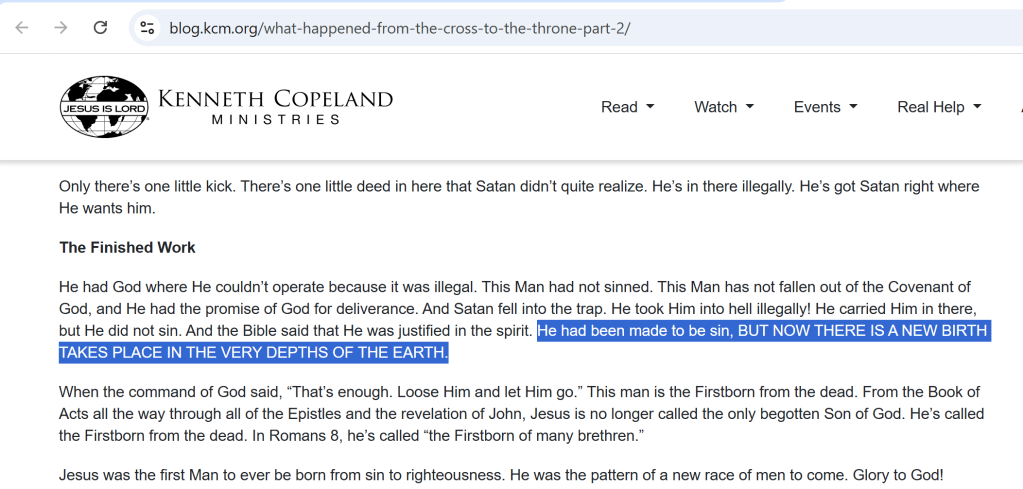
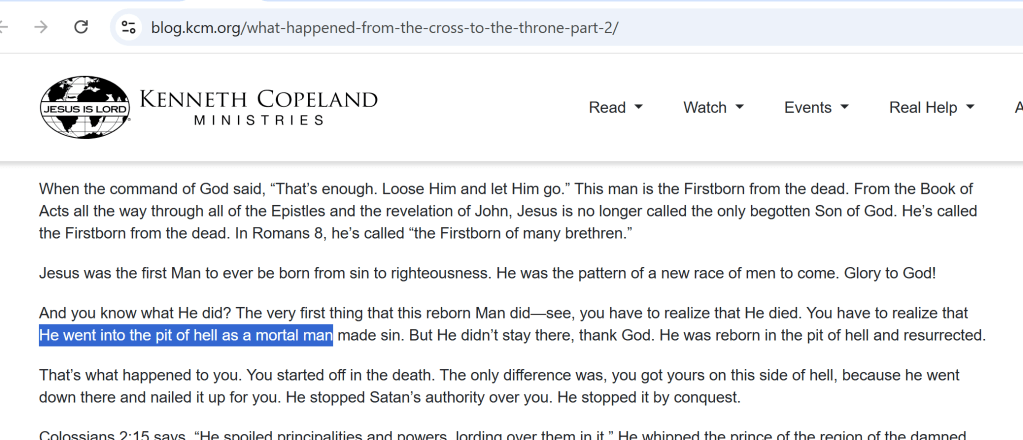
I am basing this blog post on Kenneth Copeland’s online article entitled “What Happened From The Cross To The Throne Part 2” I will share screenshots to document the false teachings in his article. This screenshot below was taken near the heading entitled “The Finished Work”. Note the highlighted areas:
Copeland above says that Jesus went to hell and was born again there. This is absurd because being born again was something God provided as a rescue for mortal sinners who need forgiveness, that would give them new spiritual life with God. Jesus was never a sinner and he did not need to be forgiven, and he already had spiritual life with God. Jesus did not need the kind of salvation that God provided as a ransom for sinners. Jesus WAS the ransom. Jesus IS salvation. Let’s look at the next highlighted area in the screenshot below.
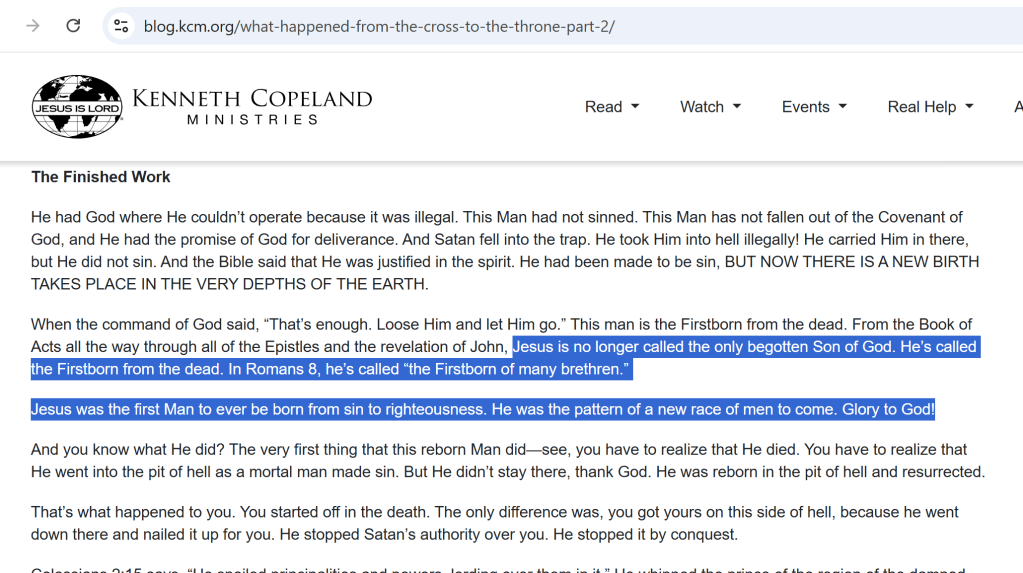
Copeland says Jesus is no longer called the only begotten Son of God from the book of Acts to John’s Revelation, but He’s called the Firstborn from the dead. Copelands definition of these two phrases are very different that what the Bible teaches. Copeland seems to say “Jesus was born again, and that he needed to be born again in order to be the leader of all Christians who need to be born again, so he could be the Firstborn of many brethren.” But the logic doesn’t follow. A Shepherd doesn’t have to become a sheep to lead the way for the sheep to be saved from danger. A Shepherd just leads them and is way above them in many ways, such as knowledge, common sense, ability and strength. A shepherd doesn’t have to eat grass to show his sheep how to keep from starving. Again the shepherd is way above the sheep but Jesus made the sheep to be drawn to eat when he created them. Jesus saves us not by being born-again himself, but by drawing us to believe in him and be saved. He stays way above us and doesn’t need to be born again to be the Firstborn of many brethren. Because He is GOD.
But Copeland says that the meaning of Jesus being begotten means Jesus was born again, but what it means Biblically is that there was only ONE conception like the conception of Jesus. That was when the Holy Spirit overshadowed Mary and God placed physical DNA inside of Mary, the physical material that would become Jesus’s body, and God placed the Soul and Spirit of Jesus in union with his body so that he would grow up in Mary’s womb. and become the God-man, God from God, Light from Light. Because believers in Jesus are “born from the dead”, Copeland conflates this in his thinking to mean Jesus and born again people are on the same playing field. The Bible teaches believers are born-again, from a place of deadness to God, and made alive to God, but we are not “God from God, Light from Light” as Jesus was. The believer retains many of his or her personality traits and cognitive and physical abilities after he or she becomes born again as they had before they were born again. We don’t give up our personalities to become saved. We are made in the image of God, but retain many of our traits, but what is new, is that we receive the spiritual fruit of Galatians 5, and other communicable attributes of Jesus, but we are not on the same playing field as Jesus in his incommunicable attributes. We are saved from the bondage to sin, and delivered out of the kingdom of darkness, where now Jesus is our new King in the Kingdom of Light. Jesus is way HIGH above us. But Copeland is demoting Jesus and making him as common as a born again person:
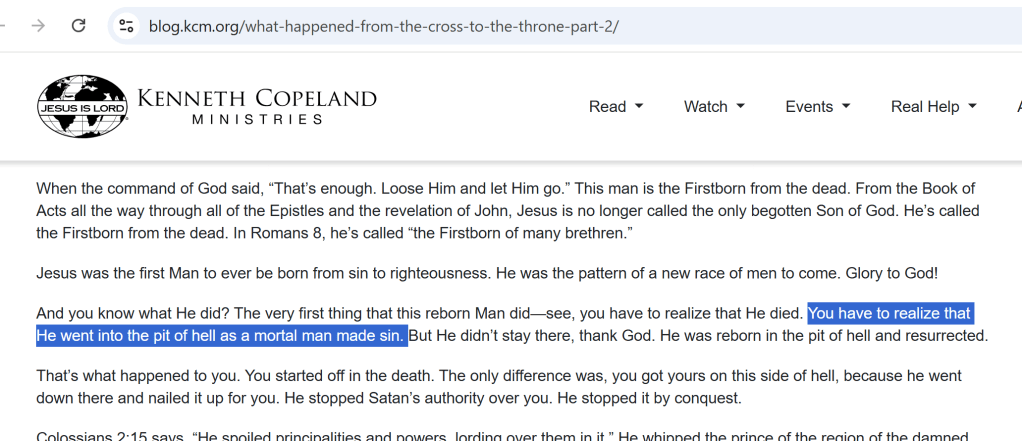
and again:
He said Jesus was just a mortal man made sin. But Jesus was the God-man, not JUST a man. The phrase Jesus “was made to be sin”, many scholars believe that it is the short way of saying Jesus became the sin offering, and that Jews of Jesus’ time would shorten the phrase “the sin offering” to “sin”. So if we plug that phrase into 2 Corinthians 5:21, it would say “For our sake he made him to be (the) sin (offering) who knew no sin, so that in him we might become the righteousness of God.” ESV parentheses mine.
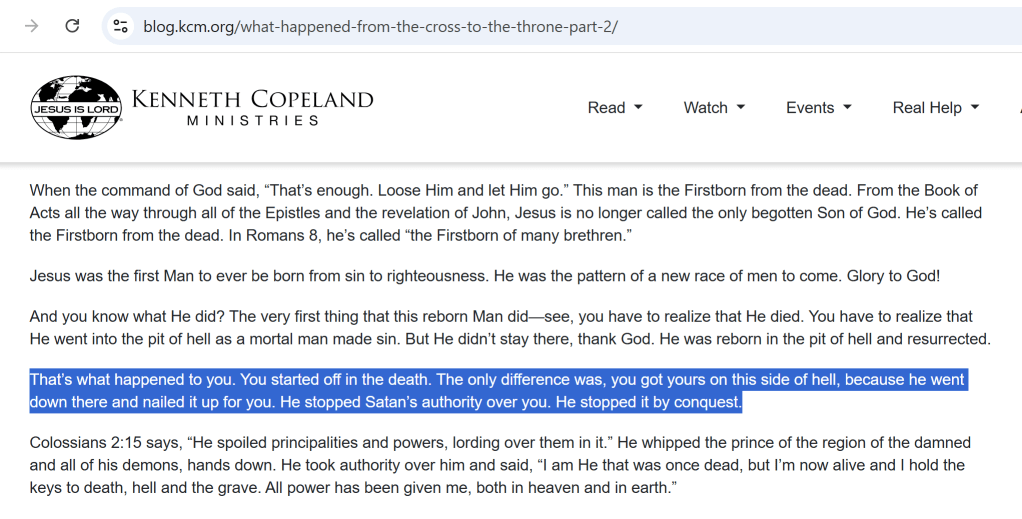
Copeland believes there are similarities between Jesus’s resurrection and the believer’s resurrection. The Bible does too. But Copeland makes up similarities between the believer and Jesus that don’t exist. Note the words below, “…the only difference…”:
When Copeland says “the only difference was, you got yours on this side of hell” I believe he is talking about the resurrection. The believers were raised up from spiritual death when they are born again on this side of heaven. True, but Copeland’s statement that Jesus went to the very pit of hell and “nailed it up for you. He stopped Satan’s authority over you. He stopped it by conquest” has tremendous problems. Copeland is talking about a conquest in hell between Satan and Jesus that we can safely say Copeland imagined, because it is no were in the Bible. In the Bible Jesus paid our sin debt in full on the cross, and then he said “it is finished” before he died. Jesus was awarded resurrection because the full wrath of God had been exhausted upon him and paid for. The righteous wrath of God had been poured out on Jesus and was satisfied, so, there was no punishment for Jesus left nor for those who would believe upon Him for him to have to go to the very PIT of hell. After Jesus died, he could go to paradise and lead captivity captive specifically because of the victory of the cross. This was the place of Abraham’s bosom. This was the place where the righteous saints who died before the resurrection of Jesus would go. So there was no conquest between Jesus and Satan in the PIT of hell.
The pit of hell would be a place of suffering and torment for those punished by God. God was the one who punished Jesus in our place on the cross. Jesus didn’t go as someone’s prisoner when he died, because “death could not hold him”, and Satan by that point was defeated, so he didn’t go to the pit of hell, but to Abraham’s bosom, or Sheol to lead captivity captive. And when he went and took captivity captive, he certainly wasn’t kept in the pit of hell by Satan, or by God but Jesus had full authority over himself after he died because he had full authority over himself while he lived each day of his life. He never gave Satan a foothold. Satan had no hold on him, and the very pit of Hell was only for those who live in sin and refuse to follow God. Jesus was successful in paying for our sins before he died. He said “It is finished, then breathed his last.” Copeland has nullified the power of the Cross:
The conquest Jesus won, was on the cross, by humbling himself, dying in our place, and taking our sins upon himself and bearing them away as the sinless lamb of God. There was no conquest between Jesus and Satan after he died because while he was on the earth, there was no physical conquest between Jesus and Satan on the earth. Satan also couldn’t lie to Jesus and be successful. Jesus just spoke the truth and resisted Satan. And Satan fled. When Jesus was crucified it was God’s plan to save the lost. Here is the victory Jesus had on earth in never sinning. Jesus’s authority over himself was in tact all the time and that was how he won the conquest against Satan:
John 8:46: “Which of you convicts me of sin? And if I tell the truth, why do you not believe Me?” (NKJV).
2 Corinthians 5:21: “For He made Him who knew no sin to be sin for us, that we might become the righteousness of God in Him” (NKJV).
1 Peter 2:22: “Who committed no sin, nor was deceit found in His mouth” (NKJV).
1 John 3:5: “And you know that He was manifested to take away our sins, and in Him there is no sin” (NKJV).
Hebrews 4:15: “For we do not have a High Priest who cannot sympathize with our weaknesses, but was in all points tempted as we are, yet without sin” (NKJV).
In the shot above after the Colossians scripture Copeland writes that Jesus took authority over Satan and said “I am He that was once dead, but I’m now alive and I hold the keys to death, hell and the grave. All power has been given me, both in heaven and in earth.” Those are 2 scriptures from Revelation 1:18, and Matthew 28:18. But Revelation gives no proof or indication that this happened when Jesus was between the cross and the throne, nor that these scriptures were spoken one after the other, nor that Jesus spoke them to Satan. Rather, when the wrath of God was paid in full, and Jesus said it is finished, Jesus went to the place of the dead to cause several old testament saints to rise with him when he would rise from the dead. There is no evidence in the Bible that Jesus spoke to Satan between the cross and the throne. Rather, the evidence seems to point to the opposite because on the cross Jesus said “It is finished”, and these words signify that he spoiled the principalities and powers by the cross. Colossians 2:15 And having disarmed the powers and authorities, he made a public spectacle of them, triumphing over them by the cross.” The Devil was not in charge of anything anymore because the atonement was paid in full, and Jesus broke the power of death, hell, and the grave, but did this on the cross, not in hell.
Was it not the sheer righteousness Jesus offered, and shed blood and what he suffered on the cross with the full wrath of God being poured out on him in the atonement and those things together were indeed the fullness of all authority to clear the sinner of sin, when Jesus said the words “It is finished”? Those 3 words were spoken after the wrath of God was poured on him to signify to us no more atonement needed to be paid. Jesus had no need for a conquest or words with the devil–the atonement was God’s business, not the devil’s, and the resurrection was God’s business demonstrating Jesus’s full authority was unstained, in tact and I believe unchallenged between the cross and the throne. *LG
The “attributes of God” are popular for study among those who seek God’s help. The attributes of God are qualities that God possesses in his personality that describe God’s God-ness. These attributes inform how our approach to God should be as they inspire worship and can also inform how we are able to pray as well as roles God readily fills for the people he has created. The attributes of God that are listed below are taken directly from the Bible. At a later time I will provide the scripture references that are associated with each God-trait.
There are two categories of attributes of God, and they are communicable and incommunicable attributes. The communicable attributes are attributes God shares with those who follow Christ and have been born again when He cleanses them from sin. The incommunicable attributes are attributes He alone as God possesses, and no other one in existence possesses. I have interspersed the two lists and attempted to make this an exhaustive list, but it was a bit difficult knowing God himself is infinite. So, I may have missed a few, but I focused on hitting the larger general areas:
1) His incarnation through Christ
2) His omnipresence
3) His omniscience
4) His omnipotence
5) His glory
6) His graciousness
7) His humanity through Jesus the Son of God
8) His holiness
9) His uncreated existence
10) His eternality
11) His divinity
12) His wisdom
13) His Saving power to save the whole person from sin, spirit mind and body
14) His mercy
15) His humility
16) His throne
17) His kingship
18) His leadership
19) His worth
20) His transcendence
21) His love
22) His joy
23) His peace
24) His patience
25) His kindness
26) His goodness
27) His faithfulness
28) His gentleness
29) His self-control or self-restraint
30) His perfection
31) His suffering
32) His righteousness
33) His incorporeality
34) His immanence
35) His compassion
36) His creatorhood
37) His infinitude
38) His Sovereignty
39) His self-existence
40) His self-sufficiency
41) His justice
42) His immutability-he never changes
43) His incomprehensibility although he allows us to know him and have a relationship with him through Christ
44) His uniqueness-only one God in all of existence
45) His unity within the Godhead, among God the Father, Son, and Holy Spirit
1 Peter 1:3 Blessed be the God and Father of our Lord Jesus Christ! According to his great mercy, he has caused us to be born again to a living hope through the resurrection of Jesus Christ from the dead
What is a Living Hope and How Does This Living Hope Affect and Impact Our Relationship to God?
God Himself has caused us to be born again! It is according to God’s great mercy that He has caused our salvation. We know whatever God starts he will finish, because he is the author and perfecter of our faith, according to Hebrews 12:2. One aspect of our hope in God is that He has His hand on our faith from the beginning to the end, and this alone points to his mercy towards us and ensures our hope in Him. The word in the Greek for the English word perfecter in Hebrews 12:2 is teleiótés, which according to Biblehub’s online Greek Lexicon (found at https://biblehub.com/lexicon/hebrews/12-2.htm) can be translated as “perfecter, completer” or “finisher”. The Greek word for the word author in the same verse is archégos, (see same biblehub.com site above) which can be translated as “founder, originator, author, prince, and leader”. So, we get from Hebrews 12:2 no matter what version of the Bible you are using, that Jesus begins or originates our faith, and perfects, or completes our faith.
This is encouraging because our faith may have many challenges, and God’s goal for us is that we mature into Christlikeness. Because our hope is living, because it is from God and Jesus holds that living hope out to us, I believe He designs and provides us opportunity for how we latch onto that living hope in a way that pleases and glorifies Him. Because our hope is in God, our view of God shapes our hope and with God in mind we are motivated to hope for things that please Him. This would include not just hope for a newer vehicle, a 4 year university education, or hope to get married, or merely temporal blessings, although our hope in God can include those things. Our hope from God includes eternal hopes. And because The God of hope provides us hope in a way that would please and honor Him we have been prompted by God to hope for these eternal things because they are made available to the believer in Christ. These could include godliness, holiness, humility, love, joy, peace, patience, kindness, goodness, faithfulness, gentleness, and self-control, and other qualities of spiritual growth to name a few.
These things should characterize our lives as believers in times when we are tempted to rush forward not giving place to them, or when we are challenged with the needs of others around us. We are prompted by God to hope for these eternal character traits, because of our awareness that God is writing the script for these qualities to be and become evident in our lives, and bring us to maturity in Christ. These things should deepen in us from simply abiding in relationship with God over time.
Therefore, we can understand the type of things our living hope is being shaped to make room for in our lives by Christ the author of our faith. These are things that have innate spiritual virtue, spiritual weight or spiritual value and things that are on a higher spiritual plane than just temporal blessings. So being born into a living hope enables us to develop Christ-likeness.
Imagine a Hope So High In Caliber
This hope so high in caliber is spoken of by Bible book writers and Bible characters again and again that they describe their relationship and the average believer’s relationship with God to be one of hope, giving us hope, pointing to our hope, strengthening our hope and describing the nature of our hope. A few examples would be from the following scriptures:
Psalm 146:5 which says “How blessed is he whose help is the God of Jacob, whose hope is in the Lord his God”.
Psalm 33:17-18 A horse is a false hope for victory; Nor does it deliver anyone by its great strength. Behold, the eye of the Lord is on those who fear Him, On those who hope for His lovingkindness,
Jeremiah 14:22 Are there any among the idols of the nations who give rain? Or can the heavens grant showers? Is it not You, O Lord our God? Therefore we hope in You, For You are the one who has done all these things.
Lamentations 3:21-22 This I recall to my mind, therefore I have hope. The Lord’s lovingkindnesses indeed never cease, For His compassions never fail.
Isaiah 40:31 Yet those who wait for the Lord will gain new strength; They will mount up with wings like eagles, they will run and not get tired, they will walk and not become weary.
Micah 7:7 as for me, I will watch expectantly for the Lord; I will wait for the God of my salvation. My God will hear me.
Romans 5:2 through whom also we have obtained our introduction by faith into this grace in which we stand; and we exult in hope of the glory of God.
Romans 15:13 Now may the God of hope fill you with all joy and peace in believing, so that you will abound in hope by the power of the Holy Spirit.
Psalm 33:22 Let Your lovingkindness, O Lord, be upon us, according as we have hoped in You.
1 Timothy 4:10 For it is for this we labor and strive, because we have fixed our hope on the living God, who is the Savior of all men, especially of believers
The benefits, privileges, mercies, and blessings of hope are truly too numerous to count, and too full to fully describe! This is truly a multifaceted, enduring hope for every situation! All of these things people were hoping in were just a small facet of the living hope that is available through faith in Christ!
This Living Hope Is Given Life Through Christ’s Resurrection and Will Culminate in the Resurrection of the Dead for the Believer
Acts 24:15 having a hope in God, which these men cherish themselves, that there shall certainly be a resurrection of both the righteous and the wicked.
Romans 6:5 For if we have been united with him in a death like his, we shall certainly be united with him in a resurrection like his.
Acts 23:6 Now when Paul perceived that one part were Sadducees and the other Pharisees, he cried out in the council, “Brothers, I am a Pharisee, a son of Pharisees. It is with respect to the hope and the resurrection of the dead that I am on trial.”
1 Thessalonians 4:13 But we do not want you to be uninformed, brothers, about those who are asleep, that you may not grieve as others do who have no hope.
Romans 8:11 If the Spirit of him who raised Jesus from the dead dwells in you, he who raised Christ Jesus from the dead will also give life to your mortal bodies through his Spirit who dwells in you.
Not only that, but the resurrection somehow solidifies the many promises about salvation that God has made over the centuries and gives firm evidence that God does not lie. Several passages in the Old Testament (see 1 Kings 17:17-24) point to the reality of the resurrection from the dead. We saw glimpses of it in his promises to Abraham when God promised him all the families of the earth will be blessed through him as Sarah was beyond childbearing years becoming pregnant with Isaac, and again with Abraham showing he believed Isaac could be risen from the dead by God. Christ lived out the hope of the resurrection to make it available to us!
As believers today that are being united with Christ in his death, we experience his life of hope flowing through us. Through faith in his salvation and because of the powers of salvation that were working and available in Christ to those who trusted in him and prayed to him before He died for the sins of the world, living hope was available to those of Old Testament times. Today, likewise we in New Testament times, through our faith in his work, because we are united with him in his death will surely be raised with Him as well, because we will be united with Him in His resurrection. What Jesus set out to do he accomplished, which is our salvation. This is simply another reason to rejoice in the truth that the undeniable reality that our living hope exists, and the born again condition of believers in Christ is full of living hope, and this hope has great spiritual value. Because the resurrection of Jesus Himself empowers this hope we are born into, we can experience multi-leveled hope in this life and in the next, and it is chock full of the mercy of God. LG
According to https://www.merriam-webster.com/dictionary/benevolent, gives 3 main descriptions for a benevolent person. First, it describes benevolence as “marked by or disposed to doing good”, such as “a benevolent donor”. 2 “organized for the purpose of doing good” such as a “benevolent society”. And 3, “marked by or suggestive of goodwill”, such as benevolent smiles.
Merriam-Webster.com goes on to say about the history of the word, it is as follows—”Benevolent has a good history. One who is benevolent genuinely wishes other people well, a meaning reflected clearly in the word’s Latin roots: benevolent comes from bene, meaning “good,” and velle, meaning “to wish.”” A benevolent person is one who wishes a person well. It is reminiscent of the greeting of John to Gaius in 3rd John 1:2 which reads, “Dear friend, I pray that all may go well with you and that you may be in good health, just as it is well with your soul.”
It also reflects the goodwill of God toward mankind in Luke 2:14 which is what the angels were announcing at Jesus Birth, which is “Glory to God in the highest, and on earth peace, good will toward men.” God’s good will was proclaimed at the very start of God’s plan of redemption. It shows nothing less than God’s own good will. Right at the very start of Jesus’s life on earth, God announced His benevolence to be heard about and to be sung about by angels and proclaimed all across the earth toward people.
Additional scriptures that support the idea of God’s benevolence or support the truth that God takes pleasure in showing His goodwill toward people are Ephesians 1:5, which reads, “He predestined us to adoption as sons to Himself through Jesus Christ according to the good pleasure of His will.” Also, as God is all wise, we see wisdom speaking in Proverbs 8:31, telling how it had been “Rejoicing in the world, His earth, And having my delight in the sons of mankind.” And Philippians 2:13 speaks of God’s good pleasure again which reads, “For God is the One working in you, both to will and to do His good pleasure.” LG
Aseity—from the website https://www.merriam-webster.com/dictionary/ aseity is “the quality or state of being self-derived or self-originated specifically: the absolute self-sufficiency, independence, and autonomy of God. A couple scripture passages that show God’s aseity are Isaiah 45:21 Declare and present your case; let them take counsel together! Who told this long ago? Who declared it of old? Was it not I, the Lord? And there is no other god besides me, a righteous God and a Savior; (this shows God’s independence and autonomy) and Isaiah 43:10, ““You are my witnesses,” declares the Lord, “and my servant whom I have chosen that you may know and believe me and understand that I am he. Before me no god was formed, nor shall there be any after me.”(this shows his absolute self-sufficiency) From Dictionary.com “An aseity is the existence of something that has no source outside of itself or that has always existed with no creation.” Or in other words, God is God all by Himself. He perfectly fills the role with no equal and with no one needing to help him be God. Although ministering to God (for example as Samuel did) and fellowshipping with God may seem to have some overlap in meaning, they are different from the idea of “helping” God exist as God because to help God be God is an oxymoron. While I believe God can take pleasure in us, and when a believer participates in fellowshipping with God and/or ministering to God, those things are the result of his people having been made a part of His kingdom but somehow those functions don’t add to God’s personal God-ness, although those functions serve to glorify His kingdom and rule. Acts 7:49-50 shows the self-sufficiency and autonomy of God, a quality of vital importance to keep in mind as we relate to him. It reads, “‘Heaven is My throne, and the earth is My footstool. What house will you build for Me? says the Lord, or what is the place of My rest? Has not My hand made all these things?’”
Over the next several weeks I hope to cover much more, as I add to this list of God’s attributes. LG
Kenneth Hagin the popular televangelist from the 1950’s to the 1990’s wrote several influential false teaching books, and we will continue looking at some of these false teachings. Romans 16:17 KJV says “Now I beseech you, brethren, mark them which cause divisions and offences contrary to the doctrine which ye have learned; and avoid them.”, so, we are going to mark them today in order to avoid them.
We will look at 4 of the false claims Hagin makes in Chapter 3 of “The Believer’s Authority” with some screenshots of the Kindle version.
They are:
False Claim # 1, Hagin says believers sit on the throne of Christ in heaven with him, during his/her life on earth, before the end of their life and before they are taken to heaven.
False Claim # 2 Believers share the equal authority of Christ’s throne with Him.
False Claim # 3 The authority of Christ’s throne is at the believer’s disposal and we should use it.
And False Claim # 4, Hagin goes one more step and says because all things are under Christ’s feet who is on the throne/ and believers ARE Christ and on His throne with Him/all things have been put under the believer’s feet
1. Hagin says believers sit on the throne of Christ in heaven with him in their life on earth. Revelation 3:21 appears to be a reward for Christians at the END OF THEIR LIFE. We do not do this during our earthly life –we are merely seated in the heavenly realms with Him. There are perhaps vast multitudes of seats in heaven—we could imagine there are enough seats in heaven for each of God’s people to have at least one place to sit. Daniel 7:27 reads “But the kingdom and the dominion and the greatness of the kingdoms under all the heavens will be given to the people, to the saints of the Most High. His kingdom is an eternal kingdom, and all dominions will worship and obey him.” The timing when the kingdom, and dominion and the greatness of the kingdom will be given to the saints of the most high seems to be when all dominions will worship and obey him–as it says in the verse–in the age to come. Not everyone in all dominions are serving him at this time, worshipping him, and obeying him now–so we know the timing of this is the future time, most likely the age to come.
Here’s the screenshot from Hagin’s book, “The Believer’s Authority, Chapter 3, entitled “Seated With Christ” Pay attention to the yellow highlighting:
Hagin says we are sharing Christ’s throne because we are seated on Christ’s throne. However the Bible says Christians ARE seated with Christ in the heavenly realms, but not on His THRONE! When we on earth are seated WITH someone in a restaurant, we are usually at the same table as they are–but not ON THEIR CHAIR. When we are seated WITH someone an a sofa, we are on the same sofa, but NOT ON THE SAME CUSHION.
So Hagin says that because we sit together with Christ, we must of course sit on Christ’s throne with Him! But the logic doesn’t follow!
Ephesians 2:6 says believers have been seated in the heavenly realms with Christ, but a realm is not the throne of Christ! If God wanted to say that believers are seated on the throne of Christ with Him He could have said that in the word, because God knows the difference between the word “realm” and the word “throne”. But the word says we are in the heavenly realms WITH Christ. And a heavenly PLACE or heavenly REALM and Christ’s THRONE are NOT THE SAME THING are they?
False Claim # 2 Believers share the authority of Christ’s throne with Him
But the Bible says it is GOD ALONE who possesses the full authority of his throne. As Christians we have a MEASURE of Christ’s authority. I believe Christians are charged to be faithful in this life in living for Christ, which if we are faithful with little we will become faithful with much. But only Christ can rightly manage his throne authority in a perfectly Godly way 100% of the time.
Here is another screenshot of Hagin’s book from Chapter 3 showing another quote about who Hagin believes gets to possess Christ’s full throne authority:
So, Colossians 1:13 is true which reads (God/Christ) “who did rescue us out of the authority of the darkness, and did translate [us] into the reign of the Son of His love” and, this authority was exercised by God. Although Hagin believes the above screenshot is true, that believers share the full authority of Christ’s throne because what was conferred upon the head is automatically conferred upon the body. But our physical bodies cannot operate without the head-the same is true for us spiritually–the believer cannot operate the authority given to us by God without Christ. The truth is believers DO NOT SHARE all the authority of Jesus’ throne—because we don’t fully know how the throne of Christ operates with full authority, so we have only some authority. We have been given authority to become children of God, to submit to God and resist the devil, and he will flee, and authority to not to have to give the devil a foothold. Other types of authority mentioned in the New Testament include the believer having authority over his/her body in a marriage relationship which is not really relevant to the study of “The Believer’s Authority” and other kinds of authority in relationships such as “building people up and not tearing them down”.
Logically speaking, Christ has also given us the necessary measure of authority to fulfill our calling, but we still need God’s help and direction and power with this, often on a daily basis and not everyone has an equal calling or equal gifting. Christians today do not have the same calling as any of the original 12 apostles did, so, logically, because we don’t have equal callings, we don’t have equal power or authority on the earth as the original 12 apostles did. We therefore certainly do not have the same power, authority and dominion as Christ! (this argument is based on looking at calling/ministry alone, comparing the callings of modern day Christians to Jesus’s ministry, aside from the obvious fact that He is God, and we are not!) There has got to be countless things Christ orchestrates from His Throne that the Christian has no knowledge of, even on a day to day basis, and that we have no direct participation in. So, to say we share the full authority of the throne of Christ is definitely Not True!
False Claim # 3 The authority of Christ’s throne is at the believer’s disposal (because we are seated on Christ’s throne) and we should learn how to use it to be victorious:
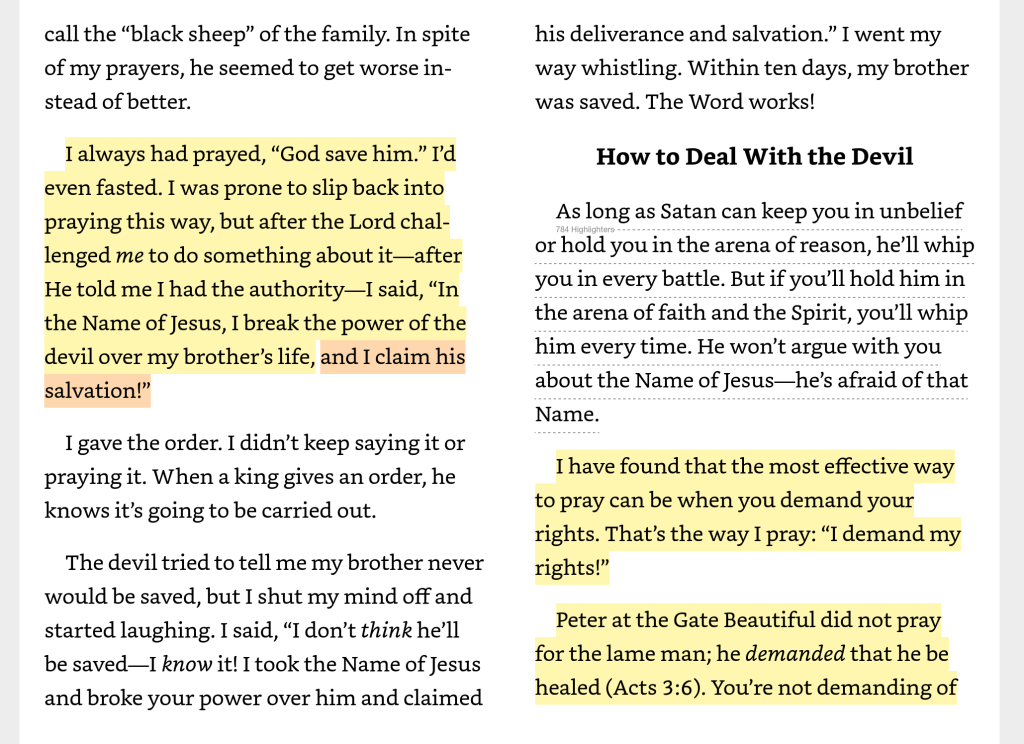
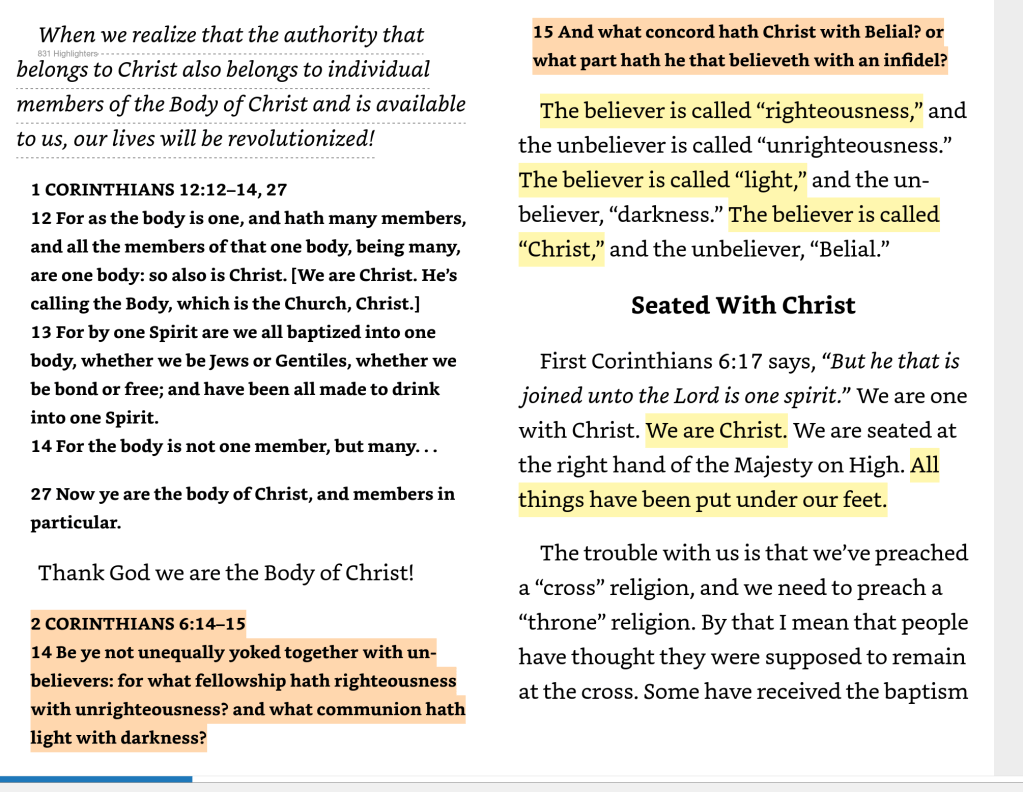
Here’s the next 3 screenshots of Hagin’s book:
He writes “if the church ever gets the revelation that we are the body of Christ, we’ll rise up and do the works of Christ.” First of all, When the Bible talks of the believer being the body of Christ, it is speaking figuratively. Christ called himself “the door” but he didn’t swing on hinges. He called himself the “bread of life” but he didn’t let his flesh get eaten by people. He called himself “The Good Shepherd” but he didn’t demand that his followers get down on all 4’s and eat grass and say “baaaa”. There is figurative language throughout the Old and New Testament, and Hagin seems oblivious to this. The body of Christ is simply “a group of followers of Christ”. So, everything that was conferred upon Christ is not directly conferred upon the followers of Christ. Christ was a martyr, and not every Christian is called to be a martyr. Christ said of his life in John 10:18 “No one has taken it away from Me, but I lay it down on My own. I have authority to lay it down, and I have authority to take it back. This commandment I received from My Father.” We as Christians need to be submitted to God and submitted to his authority and not be committed to the idea of wielding our “authority” around in the way Hagin advises. Under Christ’s authority is the safest place to be. And not assuming more than that.
There are many things Christ did that the believer is not called to do, such as travel to each of the exact cities Jesus visited, and to have the exact conversations Jesus had directly quoted from the Bible. We need to be wary of Hagin’s idea that “…the authority that belongs to Christ also belongs to individual members of the body of Christ and is available to us….” and that the authority is at the believer’s disposal. There were many things that Christ did alone as Messiah that only needed to be done by HIM. Things like His dying on the cross, things like he being whipped with a cat-o-nine tails, having to know every scripture with perfection that Christ did because He knows ALL things, plus to know the hearts of all people, and being able to answer prayer. But, because according to Hagin, we are not doing enough miracles, and not getting our lives revolutionized by that authority, because we just don’t know the things about spiritual authority like Hagin does because Hagin says that authority that belongs to Christ belongs to us, and that authority is at our disposal, Hagin says!
False Claim # 4, Hagin goes one more step and says “the believer is called righteousness”, “the believer is called light”, and “the believer is called “Christ””, and “all things have been put under our feet”( the believer’s feet). But the Bible says it is not the believer that maintains this authority because in Romans 16:20, it says “The God of peace will soon crush Satan under your feet. The grace of our Lord Jesus Christ be with you.” The Bible declares this responsibility is God’s, and that this is a free blessing of the crushing of Satan by God that God will do for the believer. Absent from the passage or even surrounding passages are any references that require the believer wielding the authority Hagin says belongs to the believer such as rebuking Satan or his demons, binding, or casting out Satan, or shouting at the devil. Hagin seems to point to these practices throughout his book as some main ways the believer is to exercise his/her authority. Hagin puts this job of doing spiritual warfare unto the shoulders of the believer. To contrast and compare, the New Testament talking about fighting the devil or demons simply tells the believer to submit to God, resist the devil and he will flee. And for the believer to stand for God with the armor of God on, and to stand up under temptation because we have been set free from the bondage of sin.
To continue with #4 which is Hagin’s thought that the believer is equal to Christ, notice how Hagin seems to enjoy putting the believer almost as a replacement for Christ. Pay attention to the highlighted areas of this next screenshot of the book:
Let’s think through this. It does not follow that believers are Christ, just because the Bible is talking about Christ in the text before in 2nd Corinthians 6:14-15. The Bible is COMPARING the believer TO CHRIST and the unbeliever to Belial.—We certainly are not pure light at this point. There are other substances in us, so how does it follow that we are pure Christ? We are not pure righteousness, because the righteousness of Christ is imputed to us, and counted in our favor even though we may have some actions which are not pure righteousness–we are in the sanctification process-not perfect yet! So how does it follow the believer is pure Christ?? Hagin’s reasoning doesn’t follow.
Are all things put under our feet? I think this will happen when the Lord takes us to heaven. Revelation 3:21 says “To the one who overcomes, I will grant the right to sit with Me on My throne, just as I overcame and sat down with My Father on His throne.” and in Matthew 19:28 it reads, “Truly I tell you, in the new world, you who have followed me will also sit on twelve thrones, judging the twelve tribes of Israel.” What is the timing of Revelation 3:21? When Christ says He will give the right for the believer to sit on his throne, He seems to be talking about what will happen to the believer in the life to come as a reward for following Christ. Matthew 19:28 was written specifically for the apostles.
The kind of victory that Hagin seems to talk about in his book “The Believer’s Authority” seems to say the Christian should never be sick, never be poor, and never be worried or anxious about anything, or having an occasional item stolen, and if you are, your not doing enough with your authority. He says the Christian must realize they are on the throne with Jesus right now. But sitting on the throne with Jesus seems to be in the future kingdom of God. Many of the troubles in life I have listed a few sentences ago are simply due to the fact that we live in a fallen world, and are not the direct result of the believer not using his “authority.” Jesus walked in perfect authority on the earth and the Bible says Judas stole finances from the ministry Jesus had complete authority over. So, is Hagin saying Jesus needed to use his authority more effectively because he was letting the enemy steal his finances? If so, Hagin is saying his personal use of authority is better than Jesus’ use of authority. Let’s look at the example Hagin uses of using “authority” to get his stolen pants back.
In the above screenshot, Hagin says he had 2 pairs of pants stolen and they were the only 2 pairs of pants good enough for him to preach in. Hagin gives this example of using his authority to be a template of what our lives as Christians should look like. Hagin says he was dealing with the spirit and not the person, but Hagin DID pray the person would be miserable so much that he would bring them back. He forgot to mention that! He attributes the success was because he told the evil spirit to stop stealing. Hagin seems to say Christians should never have any problems with being the victims of theft because Christians have authority over the demons that cause people to steal. Perhaps the Lord truly caused the person to bring back the 2 pairs of pants, but maybe God was answering Hagin’s prayer that the person would become miserable enough to bring them back, and it was because Hagin was dealing with the person, and might have not had anything to do with Hagin telling the evil spirit to “Stop the action”. The demon had already stopped the action by then anyhow. To be accurate, maybe Hagin should have told the demon to “reverse the action” if he was going to say it was his use of authority over the devil that got his pants back.
But if this is the template for Christian to follow and if it is to be the normal Christian life, there are no examples of this kind of freedom from trials for the Christian in the Bible after the apostles ministered. Even Jesus didn’t use some of these practices. We don’t see Paul demanding the devil to leave the people who were stoning him to stop, nor did Paul demand the demons holding him prisoner in Rome to stop, nor for the devil to “get his hands off his money”. We don’t see Jesus claiming Judas as his own follower or for people to truly become born again. He invited people “to come” to Him. They had to admit somewhere within that time that they were weary and heavy laden, because that is who Jesus called. No where in the New Testament (or OT) do the disciples take advantage of “claiming people for the kingdom” that Hagin speaks of in order to “do something about the salvation” of his brother.
First of all there is nothing wrong with praying “God save this person” and nothing wrong with fasting! Strangely, God seems to have “appointed” Hagin to “have an easier quick-fix” to his brother’s salvation! –To claim his brother’s salvation, and to demand your rights! –A whole lot can be said about this. Salvation BELONGS to God, and to whom God gives it. We are to ASK. There is nothing wrong with asking of fasting. Hagin makes these sound powerless. Quote “I was prone to slip back into praying this way…” but there was nothing wrong with praying “God save my brother” or to fast for their salvation. Nowhere in any place in the Bible does God tell the Minister to “claim” people for salvation. In Joshua’s day he said “as for me and my house, we will serve the Lord.” The word seems to show us that Joshua was saying he was going to lead a people that were going to serve the Lord, and that was the direction Joshua was going, and if they wanted to follow, they had to make a choice to conform to that way of life. Joshua wasn’t “creating salvation” by his words. He left up the actual choice of the people to God’s Sovereign work in their lives.
I believe many of our Christian spiritual battles are won with a good understanding of the subjects of doctrine represented in the pieces of the armor of God. (Salvation, righteousness, truth, peace, faith in God and in Christ, and a good understanding of the Word). But the New Testament does not emphasize that Christians should never be sick, have trouble with finances, or have other types of problems like fear, anxiety, or being robbed occasionally that Hagin singles out as resulting from not walking in “the authority of the believer”. What about the authority Paul walked in? Paul could heal people and rebuke demons and command people to be made well, but why didn’t he command the evil spirits that controlled the man who was involved in sexual immorality in 1 Corinthians 5:1-11 who had sexual relations with his father’s wife to stop this action? I am not saying we never need to resist the devil, but by Hagin’s example to tell the demon which caused the person to steal to “stop this action” Hagin is telling us that commanding demons seems to be the sole RIGHT WAY to find victory or to use our authority as believers. But is this truly how believers should use their authority? Or is it a better idea to ask the Lord to touch their heart and give them a change of heart? Paul recommended the people of Corinth deal in love and forgiveness with the person in 1 Corinthians 5.
I believe we should be responsible and faithful as Christians on the earth, fulfilling our calling and walking in as much submission to Christ and in as much victory as we can by grace through faith. I am not opposed to miracles, but we need to seek them only in a Biblical way. What is the picture of the Christian’s authority? I believe we still need to look to Christ, instead of trying to directly “do warfare against the devil” because we think we have the authority of Christ’s throne! Do we yell at demons when we are sick, because we think a Christian “doesn’t have to put up with that” or yell at demons when something difficult is happening to us like low finances because a Christian “doesn’t have to put up with that? Why do we not see examples of the disciples yelling at the devil when hardship came their way?
We all as Christians have proof individually that we are not in possession of the full authority of Christ’s throne because we sometimes get irritated if our car stalls out! We all have days when we have a backache or a headache! We have other aches and pains and colds and viruses! Have you had any vegetables that you had to clean out of your fridge in the last week because they got old and spoiled? Then, guess what!? All things have NOT been put under our feet. This belongs only to Jesus who reigns now in heaven. It is much more than just demons and devils that are put under Jesus’s feet! It is still possible that the God of peace could soon crush Satan underneath the feet of the believer whenever God may want to do that. But when God puts Satan under our feet, there is more that is under the feet of Christ when it says “all things are under Christ’s feet”. Satan is not ALL things! All things have been put under Christ’s feet in heaven. But there are things under Christ’s feet, simply because He is God, and He reigns in heaven and he overcame perfectly. So I don’t thing the goal of the Christian should be to seek perfect throne identity with Christ desiring that all things be placed under our feet as believers, except to submit to following Christ, and to be responsible with all the responsibilities he has entrusted to us, but in a Biblical way.
Christians are LIKE Christ but we ARE NOT Christ! We are not the Sovereign Creator. People don’t know how to make the earth turn on its axis. We don’t know how to make the clouds pour out rain. We don’t know how to put all the molecules in the right position for produce to grow and feed nations full of people. Or give life in the womb. God ALONE does, just to name a few things God can do that his people cannot do. So, all things have been placed under Jesus feet, the Lord of all creation. We are mere creatures. The authority Christians have been given to exercise on earth fits the role of people who are redeemed, We have a lesser authority than the perfect Son of God, Christians are saved from sin, who walk in a deep love for the Lord and worship Him in Spirit and Truth are those who STILL need a Savior who will operate in his distributed authority as an act of grace in our lives, because God is a good God. At the right time He Himself will soon Crush Satan underneath our feet.
The last point under the Seated With Christ heading, is that Hagin says “We are Christ”. Again, see the highlighted areas:
This friends, is demoting Christ, and elevating man…So much so that we are equal to one another. Hagin could have said “we are like Christ, or we are little Christs, (Christians) or we are united with Christ, or we belong to Christ.” The truth is Christians STILL NEED CHRIST and are dependent on Him. But to say we ARE Christ is borderline blasphemy. Hagin says this is why we have all the authority of Christ’s THRONE.
To wrap it up, Hagin has a lot of really bad false teaching and we need to mark and avoid him! While we do have some authority like the authority to become the children of God, and to submit to God, live for God, resist the devil, and he will flee, and the authority to stand against the devil and his temptations, we DO NOT HAVE ALL the authority of Christ’s throne to use at our disposal on earth is because people on the earth may only know bits and pieces of God’s will.
The Bible says we know only in part (1 Corinthians 13:9) so why would a responsible trustworthy God give the unlimited authority of Christ’s throne to his fallible children to carry out any kind of miracle they feel like doing or give them unlimited power to get each and every one of our prayers answered, to get every single sick person healed by commanding them to be healed exactly the way we want them to see this happen if we only knew bits and pieces of God’s will? If fallible people were in charge of the power of God we would leave gaping holes in the answers to prayer that should come forth, because God answers prayers in huge ways that have ripple effects, and God can see everything, and can answer everything, knows everything about everyone, and God is not selfish, and Christians sometimes struggle with that. The result would be a lot of things other than God’s will or we’d get possibly many answers falling short of God’s will that would be done on a regular basis at this point in history.
We still need a Savior–the Lord Jesus Christ! If you are like me and have put your trust in Jesus Christ to save you, we still need to practice putting off the sinful nature. This is only possible because Jesus Christ died on the cross, and put sin to death. Christ also was raised from the dead and ascended into heaven. Christ is our perfect example, and we are to continue following Him. Compared to Christ we are sinful but Christ has no sin and as God He is all-knowing and answers prayer perfectly, with his divine goodness. Born again people are told, to pray, or ASK and let our requests be made known to God. We don’t have the authority to command healing to come, or to command our prayers to come to pass. We submit to God and ASK. He alone has full authority to cause his will to come to pass and answer us because that is what His throne represents.
I hope this has been helpful. If you enjoyed it, please subscribe to this blog, and like it to let others know about it. And keep your eyes on Jesus and keep growing in the word! LG
Many Word of Faith teachers such as Kenneth Hagin, Copeland, and countless others in today’s Name It and Claim It and New Apostolic Reformation Movements say that it was Adam who forfeited the title deed of the earth to Satan after he sinned. The reason this is impossible is because Adam was never given the title deed of the earth by God to begin with. God gave Adam RESPONSIBILITY over the earth, but Adam never OWNED the earth. There was no exchange of a title deed involved. There was no verbal word from God ever telling Adam “Adam, I am making you now the owner of the earth.”
God promised Abraham and his descendants the property of Israel in Genesis 15:7. How? GOD STILL OWNED the earth at that time as he does today. Even after Adam sinned and Abraham came along God still had full dominion and ownership of the earth. It is a logical fallacy to think that Satan was in possession of the earth after Adam sinned in Genesis 3, and hundreds of years later when Abraham comes along, that God could make a promise to give the land of Israel to Abraham if Satan had the title deed to the earth.
Genesis 15:7, and 18-21 reads “And He said to him, “I am the Lord who brought you out of Ur of the Chaldeans, to give you this land to possess it.”… “On that day the Lord made a covenant with Abram, saying to your descendants I have given this land, from the river of Egypt as far as the great river, the river Euphrates: 19 the land of the Kenite, the Kenizzite, the Kadmonite, 20 the Hittite, the Perizzite, the Rephaim, 21 the Amorite, the Canaanite, the Girgashite, and the Jebusite.”
Regarding Adam’s stewardship and the responsibility God gave him, Genesis 1:26 reads, “And God said, Let us make man in our image, after our likeness: and let them have dominion over the fish of the sea, and over the fowl of the air, and over the cattle, and over all the earth, and over every creeping thing that creepeth upon the earth.” To have dominion over the plant and animal kingdoms and over all the earth is not the same thing as owning the entire earth. The Greek word in Genesis 1:26 for the word dominion, has the meaning of “to have dominion, rule, dominate”. A king can do it, or a teacher in a classroom can do it. There are different levels of dominion. God did not give Adam or Eve dominion over people. God still had ultimate dominion over all the earth, plant, and animal kingdoms and over the entire human race because when Adam and Eve sinned in Genesis 3, why did Adam and Eve hide from God?
If Adam was in charge of the earth more than God, couldn’t Adam just block God from the earth? NO, because God had full access to the earth even as He does today. Adam and Eve were subject to God. All of us are subject to God today. When Adam and Eve sinned, they knew they messed up, and they had to answer to God for their sin, and their stewardship and that is why they hid themselves. Genesis 3:8-9 says “Now they heard the sound of the Lord God walking in the garden in the cool of the day, and the man and his wife hid themselves from the presence of the Lord God among the trees of the garden. 9 Then the Lord God called to the man, and said to him, “Where are you?” 10 He said, “I heard the sound of You in the garden, and I was afraid because I was naked; so I hid myself.”
Was there a title deed and did it transfer owners or something else? A title deed of the earth would mean a person to whom it belonged would be recognized or declared as the owner of the earth or possessor of the earth. God declares himself possessor of the earth in Genesis 14:19. “Genesis 14:19 states. “And he blessed him and said, “Blessed be Abram of the Most High God, possessor of heaven and earth;…” According to Biblehub.com, it gives us the Brown-Driver-Briggs Hebrew Lexicon. This speaks of the word possessor in Gen 14:19 of God as the “possessor …as originating, creating…” heaven and earth, which is very straightforward. God called himself the possessor of the earth even after Adam’s sin. So, the “title deed” or ownership or rulership of the earth did not go to Satan.
Now concerning the scripture that speaks of Satan as God of this world, we get 2 Corinthians 4:4. In the King James Version it reads, “in whose case the god of this world has blinded the minds of the unbelieving so that they will not see the light of the gospel of the glory of Christ, who is the image of God.” That word “world” in the Greek is “aiōnos”. It means “a space of time, an age”. “…an age, a cycle (of time), especially of the present age as contrasted with the future age…”. So, 2nd Corinthians 4:4 in the Greek means Satan is “god” of this age. He is not God of this world, but simply of “this space of time or age”.
God is possessor or heaven and earth, (Gen 14:19) and over the Kingdom of Light (1 John 1:5, Rev. 22:5, Acts 26:18, Eph. 5:8, Col 1:13, Rev 21:23).
1 John 1:5 This is the message we have heard from Him and announce to you, that God is Light, and in Him there is no darkness at all.
Rev 22:5 And there shall be no night there; and they need no candle, neither light of the sun; for the Lord God giveth them light: and they shall reign for ever and ever.
Acts 26:18 To open their eyes, and to turn them from darkness to light, and from the power of Satan unto God, that they may receive forgiveness of sins, and inheritance among them which are sanctified by faith that is in me.
Eph 5:8 For ye were sometimes darkness, but now are ye light in the Lord: walk as children of light:
Col 1:13 Who hath delivered us from the power of darkness, and hath translated us into the kingdom of his dear Son:
Rev 21:23 And the city had no need of the sun, neither of the moon, to shine in it: for the glory of God did lighten it, and the Lamb is the light thereof.
Furthermore, if you need evidence that God is in control in heaven and on earth, here are three additional scriptures to stand for themselves:
Psalm 115:3 But our God is in the heavens; He does whatever He pleases.
Psalm 135:6 Whatever the Lord pleases, He does, in heaven and on earth, in the seas and in all the ocean depths.
John 1:5 The light shines in the darkness, and the darkness has not overcome it.
Satan is over the kingdom of darkness, but God’s kingdom is over Satan’s Kingdom, because God kicked Satan out of heaven and He triumphed over Satan through the cross of Christ when Christ paid for the sins of the world to be forgiven. It will soon come to pass what is written in Revelation 11:15, which reads, “Then the seventh angel sounded; and there were loud voices in heaven, saying, “The kingdom of the world has become the kingdom of our Lord and of His Christ; and He will reign forever and ever.” The word “world” in the Greek means “the world, universe; worldly affairs; the inhabitants of the world…”. Because He will reign forever and ever, Satan’s time of rule of this age will soon be over. LG
It is widely known that the Bible encourages the Christian to cultivate a healthy relationship with God. In following Christ well and being a productive Christian, we are going to encounter situations and opportunities to shape us either to become what the Bible calls a person filled with the fruits of the Spirit, or one who bears bad fruit. A third, fourth, and fifth group of persons which scripture mentions in Mark 4:1-20, are additional groups. The third group of people is one in which the seed is sown beside the path. They hear the word, Satan comes immediately and takes away what was sown. The fourth is a group in which the seed is planted in rocky soil and the seed sprouts but they have no root because there are rocks and the soil is shallow, so they can’t endure affliction or persecution and they wither; the fourth group are like seed sown among thorns, and are those who hear the word but the cares of the world, and the deceitfulness of riches enter in and choke out the word and it becomes unfruitful. In this article I will be discussing groups one and two. For groups three to five, I will be saving the discussion for a later time.
In particular, Christian fruit is categorized in Galatians 5:22-23. It says, “But the fruit of the Spirit is love, joy, peace, patience, kindness, goodness, faithfulness,gentleness, self-control; against such things there is no law.” Of these nine virtues, self-control is the last one mentioned, and in today’s culture it seems to widely be seen in diminishing quantities possibly due to several reasons. Some reasons most likely could be things such as the internet where everything is at your fingertips, with easy access for the consumer to obtain a wide variety of common vices and distractions, and the instant access we have to literally thousands of categories of purchasable things that were much harder to come by a mere 100 years ago. Because of instant gratification that is used as a replacement for God by the wayward, the wayward become moved off a course to exercise patience. The distractions come pouring in either because at worst I seek them out, or at best my defenses are low and I find it hard to fight an enemy that seems so compatible and likeable and so unassuming. I find myself believing the lie that what comes easy must have my best interest in mind, and should be what I should pursue all the while. Yet I find myself having failed again to pursue the development of self-control. I think I am growing stronger but I am paradoxically growing weaker.
These things give rise to the exercise of low tolerance, dwarfed patience, piercing impulsivity and the me first push for success. We end up with little room for the appetite for and practice of self-control. Sound familiar? The cultural scarcity of self-control has been amplified by the cultural advances in every avenue of science and industry which makes available more vices and distractions, as well as what seem to be practical and useful inventions. In spite of this the Christian in the Bible over and over is admonished to challenge him/herself to pursue holiness which includes embracing the fruits of the Spirit, which we without the help of the Spirit, cannot develop in our Christian life.
What are the implications today then on the Christian as the virtue of self-control clashes with our cultural style and approach and encroachment of secular norms? Christians are called to navigate various rocky rapids in our situational rivers in small boats with Jesus. And the widespread phenomenon in the last 50-100 years or so of a depleting of the cultural norm to see the exercise of self-control as a healthy daily expectation of oneself related to habits and business and in our entertainment choices could possibly point to the subjective value of the virtue of patience rising at least among those who seem to be depleted of it. We can assume its development in the lives of Christians who struggle with self-control could be highly desirable to them. It is the simple theory of supply and demand where the supply and demand have an inverse relationship. This states when the supply is high the demand is low and when the supply is low the demand is high..
To explain the cultural challenges we today face a little more deeply for the Christian, with our duties, jobs, chores, and schedules we may seem to have in pursuit, it seems to some as an unreachable goal, or at least impractical, although as well as can seem unrealistic, to crucify sins or the hindrances in our lives to our self control developing. To those who mean well but entertain its scarcity the hinderance of doubting its progressive development can set that the average person might prize simply because the fail to pursue self -control if loose living and it brings a great deal of peace when patience levels are high. parents and teachers and professions in which service work of any kind is involved can benefit God’s people, but self-control has value and virtue in interpersonal and business relationships even for the non-Christian. And under these conditions the Bible explains it is not only possible for the Christian to develop self-control in the midst of our dark generation, but it is also God’s delight to cause this fruit to grow and develop in our lives.
As it says in Psalm 35:27b which reads, “The Lord be exalted, Who delights in the prosperity of His servant.” It is speaking of spiritual prosperity notwithstanding material prosperity. Another virtue of Self-control is that it helps the Christian to follow Christ in living a life God can be pleased with. God is looking for open hearts to plant His word still more in them.
According to cornerstone.edu self-control is “The war between impulsivity and doing what is right or beneficial. It’s the ability to control emotions, impulses or behaviors to achieve a greater goal.”
According to Jerry Bridges, “Self-control is the exercise of inner strength under the direction of sound judgement that enables us to do, think, and say things that are pleasing to God.”
According to whatifearning.com in an article entitled “self-control and peace”, “Self-control is a societal issue (Proverbs 16:32): lack of self-control leads people to not accepting limits on their behavior and harming others through their choices. Patience is one of the keys to self-control and involves actively experiencing the time we are in, not rushing on to the next thing. It is not a passive virtue.”
Self-control is a form of inner strength because Proverbs 25:28 tells us “Like a city that is broken down and without walls is a man whose spirit is without self-restraint.”
2 Timothy 1:7 says, “For the Spirit God gave us does not make us timid, but gives us power, love and self-discipline.”
Two main kinds of self-control are self-restraint and self-discipline. Both are parts of Biblical self- control. Self-restraint has to do with stopping oneself from doing a sin or thinking sinful thoughts, while self-discipline can be more about completing a healthy habit or doing an action or step that Christ has trained us in for following Him in the pathway of righteousness.
Proverbs 29:18 says “Where there is no revelation, people cast off restraint; But blessed is the one who heeds wisdom’s instruction.”
1 Corinthians 9:24-27 Do you not know that in a race all the runners run but only one receives the prize? So run that you may obtain it. Every athlete exercises self-control in all things. They do it to receive aa perishable wreath, but we an imperishable. So, I do not run aimlessly; I do not box as one beating the air. But I discipline my body and keep it under control, lest after preaching to others I myself should be disqualified.
Titus 1:8 But hospitable, a lover of good, self-controlled, upright, holy, and disciplined.
How Does God Prepare His People to Live for Him?
Titus 2:11-14 For the grace of God has appeared, bringing salvation for all people, training us to renounce ungodliness and worldly passions, and to live self-controlled, upright, and godly lives in the present age, waiting for our great God and Savior Jesus Christ, who gave himself for us to redeem us from all lawlessness and to purify for himself a people for his own possession who are zealous for good works.
God in His word calls people to renounce ungodliness and worldly passions. What does renounce mean? According to Dictionary Definitions from Oxford Languages, it means to “formally declare one’s abandonment of (a claim, right, or possession). Similar: refuse to abide by. Reject and stop using or consuming. “he renounced drugs and alcohol completely”. In law: “refuse or resign a right or position, especially one as an heir or trustee.” Similar: to refuse to recognize or abide by any longer.” “declare that one will no longer engage in or support.” To renounce something, we declare with our actions we chose to abandon our sin and turn to God, we reject and stop using or consuming; we refuse or resign a right or position; and we declare that we will not longer engage in or support the sin, whether the sin involves action or inaction, such as in a sin of commission or omission.
We must know what sin is, or as Titus puts it, what ungodliness is and worldly passions are in order to renounce them. We must accept God’s definition of ungodliness (i.e. worldly passions or sins) if we are to be accurate in our renouncing for two main reasons: It is God Himself who lives out and knows and explains His qualities of godliness better than anyone, and He does so in the Bible, so God is the only One to accurately define and categorize the traits of ungodliness, or sin, or worldly passions, whatever you would like to call them. God warns us about sin. That is His nature because He loves us. Sin does damage and causes death, both spiritual and physical.
Over the course of about 1500 years, God chose men to write His words down, and those writings later were gathered together into a single book and became the Bible. Therefore, by reading and understanding the Bible we can know God and His traits, and we can identify and renounce things that are contrary to God, which are sin, ungodliness and worldly passions with confidence that we are renouncing real sin, real ungodliness and real worldly passions.
Does the Bible say we receive redemption from lawlessness passively or with action? It is not entirely with passivity, because we are at least thinking about that truth of salvation that it is God’s gift to us when we exercise our faith in the completed work of Christ in his work of redemption. We are moved by God to follow Christ. However, it is not our actions that cause the redemption, but redemption received by faith in Christ that results in acts of goodness coming through our lives that we have a zeal for. The zeal for good works that He gives us motivate us away from lawlessness or sin, giving us power and inner strength to renounce our sin, and point us toward godliness and holiness.
The self-control spoken of in Titus 2:11-14, which again says, “For the grace of God has appeared, bringing salvation for all people, training us to renounce ungodliness and worldly passions, and to live self-controlled, upright, and godly lives in the present age, waiting for our great God and Savior Jesus Christ, who gave himself for us to redeem us from all lawlessness and to purify for himself a people for his own possession who are zealous for good works.”, has self-control pictured as a spiritual meat, giving us spiritual strength in our Christian lives which God has combined with many other virtues like contentment, and moderation, wisdom, and gentleness, sweetness, consideration toward others, keeping in step with the Spirit, and with love, to name a few.
Let’s give a few examples of self-control to round out the picture of it in our minds.
Self-control is pictured with contentment that Moses was directed to show when he was told by God to not smite the rock but speak to it. He didn’t speak to it alone but also smote it and erred in this way and missed entering the promised land.
Self-control is pictured with moderation that Joseph showed to his brothers when they were brought before him when he planted a metal object in the supplies their horses were carrying that belonged to him, and made it look like they stole it from him to put the fear of repercussions happening to them from him as needy as they were, and he let them think about the strangeness of that mystery to haunt them about their sin of selling them into slavery, but yet He didn’t turn them away from him or kill them but provided food for them and for his father and Benjamin his brother who was left behind.
Self-control is pictured with wisdom in Solomon saving the baby’s life and discerning the liar from the real mother and giving it to her for good, and winning the respect and trust of the mass of people in his kingdom.
Self-control is pictured with gentleness and seen in Jesus many times. One such time is when the woman who was caught in the act of adultery was brought before Jesus who had many accusers. He bent down and wrote in the sand. He stood up and said He who is without sin, cast the first stone. One by one her accusers left, from the oldest first to the youngest. He said to her “woman, where are your accusers? Has no one condemned you?” she said “no one Lord” He said “neither do I condemn you. Go and sin no more.
Self-control is pictured with sweetness in the way Jesus was speaking to the 5,000 men plus women and children who had the benefit of hearing him speak, then seeing him provide bread and fish by multiplying it supernaturally, which was a lot better than a free audience giveaway on Oprah, because they got to see the Son of God in operation Himself, filling a need, giving a good talk which they would chew on and digest, and then a free lunch on the house.
Self-control is pictured with consideration toward others when Paul planed on visiting the Corinthians who accused him of being weighty in his letters but contemptible in person in 2 Corinthians but this is the same Paul who wanted to go visit them to provide them some spiritual gift that they could grow by it earlier in 1 Corinthians. He recognizes he is pictured by some as the refuse of all things, but he is doing his job as an apostle, anyway, because he loves Jesus and loves others more than he loves himself it so seems.
Self-control is seen in keeping in step with the Spirit as people were carred about to do unusual things to fulfill a plan or part of the plan of God for large numbers of people. Phineas who grabbed a sensor and offered an offering for the Israelites and stopped the plague. And it was seen in Paul and Peter’s witness among the mob who was shouting “great is Artemis of the Ephesians!” and who were a threat to becoming violent as they began their shouting match. And they kept their cool and witnessed to them. And there are many other examples of self-control used in keeping in step with the Spirit, not the least of which is Moses speaking to Pharaoh and doing miracles by the power of God which gave him time to repent and then leading God’s people out of Egypt safely to the promised land. And Daniel following the Lord’s lead instead of what his leaders wanted and keeping true to the Lord and being adaptable to God in prayer, even when it wasn’t comfortable and being thrown in the lions den, and Ezekiel having to lay on his side and be ill in prayer for 390 days as a sign to people and also perhaps because of the spiritual intensity of what principalities and powers he was fighting in prayer, strengthened by God to oppose the will of the enemy and be in favor to the will of God.
What better example of love coupled with self-control than when Jesus upon the cross saw them hurling insults at Him and saying “if you are the Son of God call the angels of God to come and take you down off the cross! And He forgave them and said “Father, forgive them for they know not what they do.” He offered forgiveness to the ones inflicting violent pains upon Him. And another example of self-control coupled with love, which was Noah preparing an ark for his family was moved with Godly fear and humility, and prepared an ark for himself and his family and witnessed to the people of his day that God was going to judge the earth with a flood, even though it got him many many insults and mockery.
Self-control when coupled by the people of God to different virtues was often successful to strengthen them to follow Him and keep them safe from harm, deliver them from dangers and perils, and cause them to bear fruit and aide them in the process of trusting God as He was leading and providing for them. Every Christian needs this virtue in operation, and if it is not there or weakly appearing in our lives, God will make sure we have opportunities for our exercise of it. Self-control is akin to patience because when we think about countering our fleshly indulgences that in spite of our best intentions sometimes flare up we discover the need to crucify them as scripture instructs. Our fleshly indulgencies such as overeating, gambling, swearing, stealing, lust and others, may be found are often engaged in with impulse, and to counter an impulse you must practice self-control, patience and initiative.
The Christian life is a challenging one without argument and involves self-sacrificing of comforts, conveniences, pleasantries, sometimes our plans and even sometimes other advantages for the sake of knowing Christ, and His role among the Triune God’s work upon the earth. The securities we feel like things are always going to be familiar for us in our paths of faith giving us a false notion they will always be available can be sometimes had by Christians. God may take one or more of these comforts by God’s prerogative out of the lives of His people. For instance, Elijah’s brook that dried up, and the manna that God provided to the Israelites one day stopped when God was ready to bring them in to the land He had promised them along their journey homeward. To keep this in mind helps us to be patient and self controlled if those comforts for some reason are taken away or removed by God to give us a chance of growth or pruning God may be doing.
As we see this virtue of self-control in operation through Biblical example, let us make room for it’s use in our hearts, and for it’s virtue coming from God Himself to minister to us, and hold Christ as set apart in our hearts as Lord and sanctified giver of the true grace of self-control, so that it’s operation to reflect the glory of God may be seen as a true witness by those we encounter wherever God may lead us to go. LG



 groenintheword.blog