I wanted to write on the the verse Hebrews 7:25 today because it can answer many questions regarding salvation.
Hebrews 7:25 reads “Consequently, he is able to save to the uttermost those who draw near to God through him, since he always lives to make intercession for them.”
This scripture is talking about Jesus, and speaks of the wonderful fact that he is the unique Savior of the world. God knows every need we will ever have, and this states he is able to save (people) to the uttermost. The scripture is speaking about those who draw near to God through Him (Jesus).
What did the writer of Hebrews intend with the choice of the word uttermost? If we look up the original meaning of the word uttermost in the early Greek manuscript, the word is uttermost is taken from the word “pantelés”. Panteles means “all; full-ended; entire; completion”. See https://biblehub.com/greek/3838.htm
This truth is definitely an encouragement to those who are wondering if God is enough. Or for those who question how deep God’s work of salvation is, he saves people to the uttermost. This covers every base, every personal weakness, every type of position people are in now and in the future and even those who feel like they don’t know if they can bring what is required “to the table”. The truth is the scripture says salvation comes to people not because they bring their righteousness to the table, because God (and Jesus) have already “set the table” so to speak as far as what is required for salvation.
Salvation in God’s plan for the world to be saved, required nothing less than Jesus’ perfect life of obedience and sacrificial love. It has already been paid in full by Jesus’ giving his perfect life to God as an offering for my account and your account. This is God’s great news to us!
God intends to grant people the wisdom in their saving relationship with Him to learn His ways. This wisdom unfolds in the lives of God’s people as a natural part of God the Father being a good father to us. The believer simply should remain open to God, by reading his word. God is able to teach us and train us in living a life of faith. We should simply talk to our Heavenly Father as a real person, as the one who is able to meet every need. Through dwelling with God in faith, going to him with our questions, our concerns, our thanks, as we keep trusting him to guide us and provide for us, our faith can grow, and we can find we are getting to know our Father God and Jesus as the graceful people they are. God’s plan of salvation for you is a good one. Are you willing to let today be the day you put your roots of faith in God for his salvation? He is able to save us to the uttermost. LG
I am writing this article to show plainly that Kenneth Copeland on his website is teaching the idea that Jesus was born again in hell, and the ridiculousness of this idea, and why this idea is a false teaching, and Copeland’s misunderstanding of Jesus’s authority.
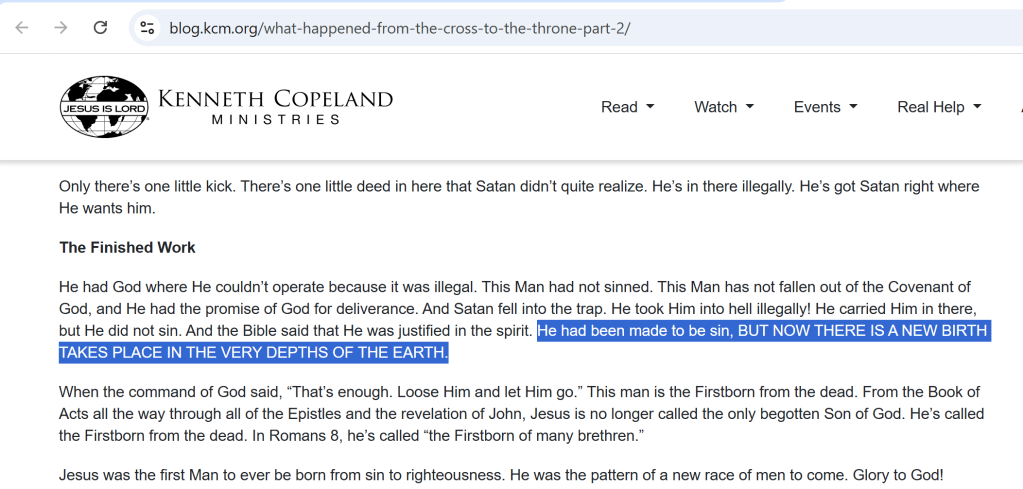
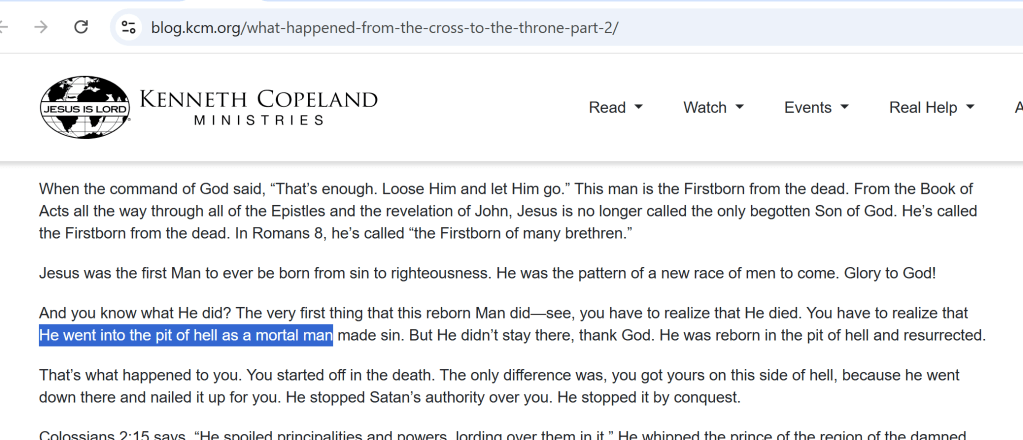
I am basing this blog post on Kenneth Copeland’s online article entitled “What Happened From The Cross To The Throne Part 2” I will share screenshots to document the false teachings in his article. This screenshot below was taken near the heading entitled “The Finished Work”. Note the highlighted areas:
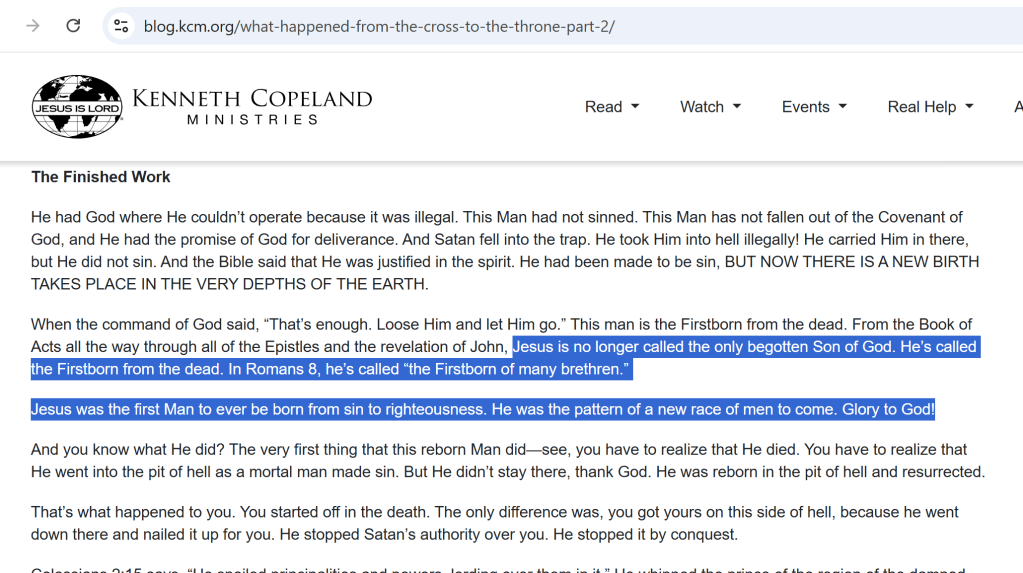
Copeland above says that Jesus went to hell and was born again there. This is absurd because being born again was something God provided as a rescue for mortal sinners who need forgiveness, that would give them new spiritual life with God. Jesus was never a sinner and he did not need to be forgiven, and he already had spiritual life with God. Jesus did not need the kind of salvation that God provided as a ransom for sinners. Jesus WAS the ransom. Jesus IS salvation. Let’s look at the next highlighted area in the screenshot below.
Copeland says Jesus is no longer called the only begotten Son of God from the book of Acts to John’s Revelation, but He’s called the Firstborn from the dead. Copelands definition of these two phrases are very different that what the Bible teaches. Copeland seems to say “Jesus was born again, and that he needed to be born again in order to be the leader of all Christians who need to be born again, so he could be the Firstborn of many brethren.” But the logic doesn’t follow. A Shepherd doesn’t have to become a sheep to lead the way for the sheep to be saved from danger. A Shepherd just leads them and is way above them in many ways, such as knowledge, common sense, ability and strength. A shepherd doesn’t have to eat grass to show his sheep how to keep from starving. Again the shepherd is way above the sheep but Jesus made the sheep to be drawn to eat when he created them. Jesus saves us not by being born-again himself, but by drawing us to believe in him and be saved. He stays way above us and doesn’t need to be born again to be the Firstborn of many brethren. Because He is GOD.
But Copeland says that the meaning of Jesus being begotten means Jesus was born again, but what it means Biblically is that there was only ONE conception like the conception of Jesus. That was when the Holy Spirit overshadowed Mary and God placed physical DNA inside of Mary, the physical material that would become Jesus’s body, and God placed the Soul and Spirit of Jesus in union with his body so that he would grow up in Mary’s womb. and become the God-man, God from God, Light from Light. Because believers in Jesus are “born from the dead”, Copeland conflates this in his thinking to mean Jesus and born again people are on the same playing field. The Bible teaches believers are born-again, from a place of deadness to God, and made alive to God, but we are not “God from God, Light from Light” as Jesus was. The believer retains many of his or her personality traits and cognitive and physical abilities after he or she becomes born again as they had before they were born again. We don’t give up our personalities to become saved. We are made in the image of God, but retain many of our traits, but what is new, is that we receive the spiritual fruit of Galatians 5, and other communicable attributes of Jesus, but we are not on the same playing field as Jesus in his incommunicable attributes. We are saved from the bondage to sin, and delivered out of the kingdom of darkness, where now Jesus is our new King in the Kingdom of Light. Jesus is way HIGH above us. But Copeland is demoting Jesus and making him as common as a born again person:
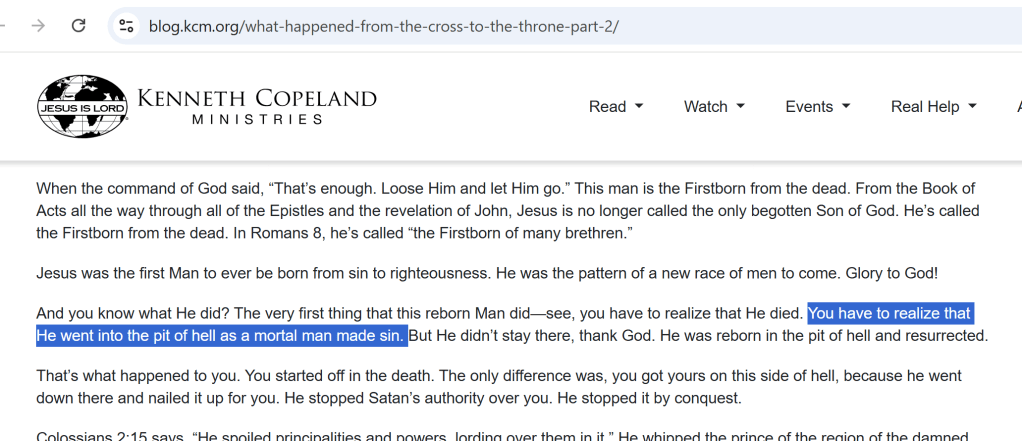
and again:
He said Jesus was just a mortal man made sin. But Jesus was the God-man, not JUST a man. The phrase Jesus “was made to be sin”, many scholars believe that it is the short way of saying Jesus became the sin offering, and that Jews of Jesus’ time would shorten the phrase “the sin offering” to “sin”. So if we plug that phrase into 2 Corinthians 5:21, it would say “For our sake he made him to be (the) sin (offering) who knew no sin, so that in him we might become the righteousness of God.” ESV parentheses mine.
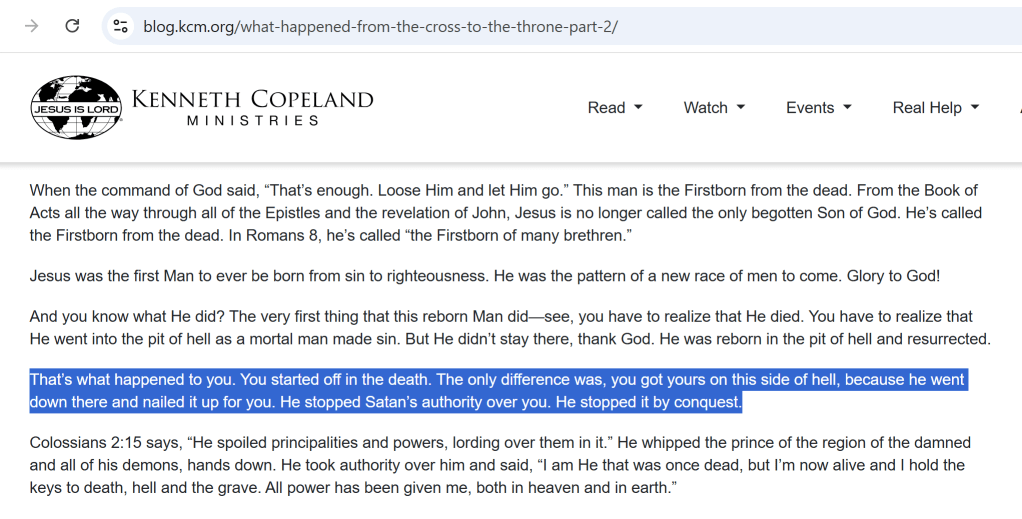
Copeland believes there are similarities between Jesus’s resurrection and the believer’s resurrection. The Bible does too. But Copeland makes up similarities between the believer and Jesus that don’t exist. Note the words below, “…the only difference…”:
When Copeland says “the only difference was, you got yours on this side of hell” I believe he is talking about the resurrection. The believers were raised up from spiritual death when they are born again on this side of heaven. True, but Copeland’s statement that Jesus went to the very pit of hell and “nailed it up for you. He stopped Satan’s authority over you. He stopped it by conquest” has tremendous problems. Copeland is talking about a conquest in hell between Satan and Jesus that we can safely say Copeland imagined, because it is no were in the Bible. In the Bible Jesus paid our sin debt in full on the cross, and then he said “it is finished” before he died. Jesus was awarded resurrection because the full wrath of God had been exhausted upon him and paid for. The righteous wrath of God had been poured out on Jesus and was satisfied, so, there was no punishment for Jesus left nor for those who would believe upon Him for him to have to go to the very PIT of hell. After Jesus died, he could go to paradise and lead captivity captive specifically because of the victory of the cross. This was the place of Abraham’s bosom. This was the place where the righteous saints who died before the resurrection of Jesus would go. So there was no conquest between Jesus and Satan in the PIT of hell.
The pit of hell would be a place of suffering and torment for those punished by God. God was the one who punished Jesus in our place on the cross. Jesus didn’t go as someone’s prisoner when he died, because “death could not hold him”, and Satan by that point was defeated, so he didn’t go to the pit of hell, but to Abraham’s bosom, or Sheol to lead captivity captive. And when he went and took captivity captive, he certainly wasn’t kept in the pit of hell by Satan, or by God but Jesus had full authority over himself after he died because he had full authority over himself while he lived each day of his life. He never gave Satan a foothold. Satan had no hold on him, and the very pit of Hell was only for those who live in sin and refuse to follow God. Jesus was successful in paying for our sins before he died. He said “It is finished, then breathed his last.” Copeland has nullified the power of the Cross:
The conquest Jesus won, was on the cross, by humbling himself, dying in our place, and taking our sins upon himself and bearing them away as the sinless lamb of God. There was no conquest between Jesus and Satan after he died because while he was on the earth, there was no physical conquest between Jesus and Satan on the earth. Satan also couldn’t lie to Jesus and be successful. Jesus just spoke the truth and resisted Satan. And Satan fled. When Jesus was crucified it was God’s plan to save the lost. Here is the victory Jesus had on earth in never sinning. Jesus’s authority over himself was in tact all the time and that was how he won the conquest against Satan:
John 8:46: “Which of you convicts me of sin? And if I tell the truth, why do you not believe Me?” (NKJV).
2 Corinthians 5:21: “For He made Him who knew no sin to be sin for us, that we might become the righteousness of God in Him” (NKJV).
1 Peter 2:22: “Who committed no sin, nor was deceit found in His mouth” (NKJV).
1 John 3:5: “And you know that He was manifested to take away our sins, and in Him there is no sin” (NKJV).
Hebrews 4:15: “For we do not have a High Priest who cannot sympathize with our weaknesses, but was in all points tempted as we are, yet without sin” (NKJV).
In the shot above after the Colossians scripture Copeland writes that Jesus took authority over Satan and said “I am He that was once dead, but I’m now alive and I hold the keys to death, hell and the grave. All power has been given me, both in heaven and in earth.” Those are 2 scriptures from Revelation 1:18, and Matthew 28:18. But Revelation gives no proof or indication that this happened when Jesus was between the cross and the throne, nor that these scriptures were spoken one after the other, nor that Jesus spoke them to Satan. Rather, when the wrath of God was paid in full, and Jesus said it is finished, Jesus went to the place of the dead to cause several old testament saints to rise with him when he would rise from the dead. There is no evidence in the Bible that Jesus spoke to Satan between the cross and the throne. Rather, the evidence seems to point to the opposite because on the cross Jesus said “It is finished”, and these words signify that he spoiled the principalities and powers by the cross. Colossians 2:15 And having disarmed the powers and authorities, he made a public spectacle of them, triumphing over them by the cross.” The Devil was not in charge of anything anymore because the atonement was paid in full, and Jesus broke the power of death, hell, and the grave, but did this on the cross, not in hell.
Was it not the sheer righteousness Jesus offered, and shed blood and what he suffered on the cross with the full wrath of God being poured out on him in the atonement and those things together were indeed the fullness of all authority to clear the sinner of sin, when Jesus said the words “It is finished”? Those 3 words were spoken after the wrath of God was poured on him to signify to us no more atonement needed to be paid. Jesus had no need for a conquest or words with the devil–the atonement was God’s business, not the devil’s, and the resurrection was God’s business demonstrating Jesus’s full authority was unstained, in tact and I believe unchallenged between the cross and the throne. *LG
The truth is all of us have sinned. We’ve all fallen short of the glory of God. (Romans 3:23)
I don’t mean God isn’t interested in our obedience, because He is! (Romans 1:5) But He must save us first before we can have the kind of obedience he is looking for! (2 Timothy 1:9, Galatians 3:6-9) When God begins with us, we deserve God’s wrath for eternity because it’s about who we’ve sinned against. Why is sin so serious? –because of who we’ve sinned against. The greater the person to whom a wrong is done, the greater the wrong that is done. It’s ultimately against God that we’ve sinned. Every sin we commit is against God in the least sense and against two or more persons in the broadest sense.
God cannot and does not need our efforts to save us because Jesus said it is finished. (John 19:30) It would go against God’s aseity if salvation were dependent on us, (Psalm 3:8) and if it’s against His aseity, it’s against his nature. (Isaiah 45:5, Psalm 86:10) And it would go against what Jesus said if it were not finished but was dependent on us. And that would make Jesus a liar, and he is not! That would make him not Lord but he is Lord! (1 Corinthians 8:6, John 20:28)
If he needed us to do part of the work of our own salvation, and we sometimes err, that means I will or could potentially mess up if it were dependent on me, because erring is the very reason we need salvation. (Romans 3:23) And if my salvation depended on myself, and not God, that potential for error could or would somehow get translated into the work of salvation in my life IF the work of salvation was somehow my work. (Ecclesiastes 7:20, John 3:19) But it’s NOT, it’s God’s work in spite of our work, (Isaiah 57:18) it’s God’s work in place of our work, (Genesis 15:12-21) his work in times of us bewildered because of our failure, (Job 42:6) it’s God’s work in exchange for our work, (2 Corinthians 5:21) it’s God’s work because we don’t have the capacity to work it out left to ourselves, (Romans 5:6) it’s God’s work and him taking the initiative because He sees our work is broken.(Genesis 3:21) It’s God working and us resting in him, Him doing and us trusting, because his work is everlasting (Jeremiah 31:3, Isaiah 41:28) and even when we feel frozen, (Psalm 46:10) or pausing because of our loud weaknesses, (Matthew 26:75) it’s God’s strength made perfect in our weakness (2 Corinthians 12:9).
The act of him making us born again is his work 100%. (Isaiah 43:11, Hosea 13:4) That saves us from having to produce the work of making us holy. He will make us holy and he’ll do it by using our obedience (Leviticus 20:8) but not because he is short on obedience but uses ours to shape us. (2 Corinthians 3:18, Romans 8:29). So He is totally in control of the work of saving and sanctifying us. He began the good work and He will finish it.(Philippians 1:6) He is the author and perfector of our faith. (Hebrews 12:2) He is the birther of our walk of service to God, (Exodus 23:25) the designer of it, the upholder of our salvation, (Isaiah 41:13) the producer of it, (1 John 5:4-12) the continuer or it (John 8:31-32) and the founder and completer (Hebrews 11:10, 12:25-29) of the life given by God (1 Corinthians 3:11)
It has to be his work, or it cannot be pure; (2 Samuel 22:7, Habakkuk 1:13) it must be his work or it’s not trustworthy; (Psalm13:5, Isaiah 26:3-4) his work (Revelation 7:10) or it’s not genuine from start to finish. (1 Peter 1:7) And there is only one type of thing from us he needs and that is our failures and sins, our errors and impurities, our falling short and our inadequacies, our blotches and our messes, our missing the mark, and our misunderstandings. Then it’s real! (Colossians 2:14, Galatians 3:14) LG
The “attributes of God” are popular for study among those who seek God’s help. The attributes of God are qualities that God possesses in his personality that describe God’s God-ness. These attributes inform how our approach to God should be as they inspire worship and can also inform how we are able to pray as well as roles God readily fills for the people he has created. The attributes of God that are listed below are taken directly from the Bible. At a later time I will provide the scripture references that are associated with each God-trait.
There are two categories of attributes of God, and they are communicable and incommunicable attributes. The communicable attributes are attributes God shares with those who follow Christ and have been born again when He cleanses them from sin. The incommunicable attributes are attributes He alone as God possesses, and no other one in existence possesses. I have interspersed the two lists and attempted to make this an exhaustive list, but it was a bit difficult knowing God himself is infinite. So, I may have missed a few, but I focused on hitting the larger general areas:
1) His incarnation through Christ
2) His omnipresence
3) His omniscience
4) His omnipotence
5) His glory
6) His graciousness
7) His humanity through Jesus the Son of God
8) His holiness
9) His uncreated existence
10) His eternality
11) His divinity
12) His wisdom
13) His Saving power to save the whole person from sin, spirit mind and body
14) His mercy
15) His humility
16) His throne
17) His kingship
18) His leadership
19) His worth
20) His transcendence
21) His love
22) His joy
23) His peace
24) His patience
25) His kindness
26) His goodness
27) His faithfulness
28) His gentleness
29) His self-control or self-restraint
30) His perfection
31) His suffering
32) His righteousness
33) His incorporeality
34) His immanence
35) His compassion
36) His creatorhood
37) His infinitude
38) His Sovereignty
39) His self-existence
40) His self-sufficiency
41) His justice
42) His immutability-he never changes
43) His incomprehensibility although he allows us to know him and have a relationship with him through Christ
44) His uniqueness-only one God in all of existence
45) His unity within the Godhead, among God the Father, Son, and Holy Spirit
Jesus asked his disciples one day in Luke 6:26 “Why do you call Me, ‘Lord, Lord,’ and not do what I say?” Now aside from this being a very direct question it was one that was intended to bring self-reflection to the disciples to help them evaluate whether or not they were just giving lip service to the Lord and falling short of living in obedience to the Lord they professed to follow. I wrote in another post earlier today that the Biblical definition of Lord in the Greek according to https://biblehub.com/greek/2962.htm is kýrios – “properly, a person exercising absolute ownership rights; lord (Lord). He to whom a person or thing belongs, about which he has the power of deciding; master, lord; used… universally, of the possessor and disposer of a thing, the owner.” Thayer’s Greek Lexicon on the same webpage says, “this title is given to God, the ruler of the universe.” These qualities demand, but not just demand, they encourage, they promote, they spur us on toward loving Jesus in loving obedience.
Romans 1:5 Through Him we have received grace and apostleship for the obedience of faith among all nations for His name, 6 among whom you also are called by Jesus Christ:
Romans 16:25-27 Now to Him who has power to establish you according to my gospel and the preaching of Jesus Christ, according to the revelation of the mystery, which was kept secret for long ages past, 26 but now is revealed by the prophetic Scriptures according to the commandment of the everlasting God, made known to all the Gentiles for the obedience of faith, 27 to the only wise God, through Jesus Christ, to whom be glory forever. Amen.
Matthew 7:24-29“Whoever hears these sayings of Mine and does them, I will liken him to a wise man who built his house on a rock. 25 And the rain descended, the floods came, and the winds blew and beat on that house. And it did not fall, for it was founded a rock. 26 And every one who hears these sayings of Mine and does not do them will be likened to a foolish man who built his house on the sand. 27 And the rain descended, the floods came, and the winds blew and beat on that house. And it fell. And its fall was great.” 28 When Jesus finished these sayings, the people were astonished at His teaching, 29 for He taught them as one having authority, and not as the scribes.
Reflection: How is Christ prompting you to obey Him? What areas of your life seem weak in comparison with the scripture you know? How would the Lord have you pray to strengthen the areas you experience weakness? What would the Lord have you to apply to your life to honor the admonitions we see for the Christ follower in the scripture? Is there a person in your life you can share your prayer concerns with and pursue seeking the Lord’s help in becoming a better follower and doer of the word? LG
The Biblical definition of Lord in the Greek according to https://biblehub.com/greek/2962.htm is kýrios – properly, a person exercising absolute ownership rights; lord (Lord). He to whom a person or thing belongs, about which he has the power of deciding; master, lord; used… universally, of the possessor and disposer of a thing, the owner. Thayer’s Greek Lexicon on the same webpage says this title is given to God, the ruler of the universe.
True faith must have the right understanding of the identity of God and Jesus:
The Bible declares the Lord is God:
Exodus 15:2 TheLordis my strength and song, and He has become my salvation. He is my God, and I will praise Him; my father’s God, and I will exalt Him.
Exodus 18:11 Now I know that theLordis greater than all gods, for in the matter in which they treated thepeople insolently, He was above them.”
Exodus 34:14 (for you shall not worship any other god, for theLord, whose name is Jealous, is a jealous God),
Deuteronomy 3:24 “O LordGod, You have begun to show Your servant Your greatness, and Your mighty hand, for what godisthere in heaven or in earth that can do according to Your works and according to Your might?
The next Bible verse tells us there is such a thing as “God of Gods” and “Lord of Lords” which is one person—the Lord your God— which we see from this Deuteronomy verse:
Deuteronomy 10:17 For the Lord your God is the God of gods and Lordoflords, the great, the mighty, and the fearsome God who is unbiased and takes no bribe.
Evidence That Jesus is Lord:
The Bible declares Jesus is Lord in numerous scriptures, and that Jesus is the Lord of Lords. Many people wh lived in Jesus’ day gave Jesus the title “Lord” and Jesus never corrected them. Some of them are
Matthew 4:7 Jesus said to him, “It is also written, ‘You shall not tempt the Lord your God.’ ” Jesus spoke this to Satan who was trying to tempt Him.
Matthew 9:28 When He entered the house, the blind men came to Him. And Jesus said to them, “Do you believe that I am able to do this?” They said to Him, “Yes, Lord.”
1 Timothy 6:12 Fight the good fight of faith. Lay hold on eternal life, to which you are called and have professed a good profession before many witnesses. 13 I command you, in the sight of God, who gives life to all things, and in the sight of Christ Jesus, who testified a good confession before Pontius Pilate, 14 to keep this commandment without blemish, blameless until the appearing of our Lord Jesus Christ, 15 which He, who is the blessed and only Ruler, the King of kings and Lord of lords, will reveal at the proper time. 16 He alone has immortality, living in unapproachable light, whom no one has seen, nor can see. To Him be honor and everlasting power. Amen.
Luke 5:12 When He was in a certain city, a man full of leprosy, upon seeing Jesus, fell on his face and begged Him, “Lord, if You will, You can make me clean.”
The above scriptures show Jesus is Lord, and Because Jesus is Lord, Jesus is God because The Lord is God:
Now we are onto scriptures showing Jesus is the Lamb of God
John 1:29 The next day John saw Jesus coming toward him and said, “Look, the LambofGod, who takes away the sin of the world.
John 1:36 Looking upon Jesus as He walked, he said, “Look, the LambofGod!”
1 Peter 1:18-20 For you know that you were not redeemed from your vain way of life inherited from your fathers with perishable things, like silver or gold, 19 but with the precious blood of Christ, as of a lamb without blemish and without spot.20 He was foreordained before the creation of the world, but was revealed in these last times for you.
The Lamb of God is Jesus, so the next verse tells us Jesus (the Lamb of God) is the Lord of lords and King of kings
Revelation 17:14 These will wage war with the Lamb, but the Lamb will overcome them, for He is Lord of lords and King of kings. Those who are with Him are called and chosen and faithful.”
The next following verses tell us Jesus the Lamb has qualities only God possesses:
Revelation 5:12 saying with a loud voice: “Worthy is the Lamb who was slain, to receive power and riches and wisdom and strength and honor and glory and blessing!”
Revelation 5:13 Then I heard every creature which is in heaven and on the earth and under the earth and in the sea, and all that are in them, saying: “To Him who sits on the throne and to the Lamb be blessing and honor and glory and power, forever and ever!”
Revelation 7:10 They cried out with a loud voice: “Salvation belongs to our God who sits on the throne, and to the Lamb!”
Revelation 7:17 for the Lamb who is in the midst of the throne will shepherd them and ‘He will lead them to springs of living water.’ ‘And God will wipe away every tear from their eyes.’”
Revelation 13:8 All who dwell on the earth will worship him, all whose names have not been written in the Book of Life of the Lamb who was slain from the foundation of the world.
Revelation 14:4 These are those who were not defiled with women, for they are virgins. These are those who follow the Lamb wherever He goes. These were redeemed from among men, as first fruits to God and to the Lamb.
Revelation 21:23 The city has no need of sun or moon to shine in it, for the glory ofGod is its light, and its lamp is the Lamb.
Because of discovering the overlap with these Biblical titles for Jesus, we become better equipped for the posture we must take as Christians in response to the revealing of these aspects of the person of Jesus.
Prayer: Dear Lord Jesus, may our posture toward you in prayer, worship and everyday life reflect the knowledge that you are Lord, you are God, and that you are the Lamb of God who takes away our sin. May the outworking of our faith in this life honor you as Lord, Savior, and God, and when we fall short of your glory, may the touch of the Lamb strengthen us as we think about how familiar you were with human frailty and how familiar you are with our griefs. May our fellowship with you be one of humility because of your example as we see your approach toward us is that of a humble Lamb. As we encounter people of other faiths who may have been taught errors instead of facts about you Jesus, Lord may we follow your gentle approach and example that you have shown to us, and may you prepare us with truth to share in ways that can bring them real hope and the true sense of your grace, because it was you who demonstrated the laying down of your life for the sins of the world, the ultimate humility and graciousness. May more and more people through taking in of the scriptures such as the ones listed above dear Lord become aware that salvation came from you in these aspects as you filled these titles and qualities you lived out in your life on earth and on the cross and currently possess in heaven. For you said Jesus, as the Lamb who died on the cross for us, the words “It is finished”. These words showed you opened the way of salvation for the world in need of it to come simply through faith, because you were slain on the cross for our sins and did this as Lord, as God, and true salvation can only come through God, not as a work of a man. Lord Jesus you fulfilled the role of the Lamb of God that was slain from the foundation of the world and now are present in heaven as Lord, God, and Lamb of God. May these truths ever inform our walk of faith with you, our prayer, in our devotion, and in our sharing this hope of salvation with others. LG
Aseity—from the website https://www.merriam-webster.com/dictionary/ aseity is “the quality or state of being self-derived or self-originated specifically: the absolute self-sufficiency, independence, and autonomy of God. A couple scripture passages that show God’s aseity are Isaiah 45:21 Declare and present your case; let them take counsel together! Who told this long ago? Who declared it of old? Was it not I, the Lord? And there is no other god besides me, a righteous God and a Savior; (this shows God’s independence and autonomy) and Isaiah 43:10, ““You are my witnesses,” declares the Lord, “and my servant whom I have chosen that you may know and believe me and understand that I am he. Before me no god was formed, nor shall there be any after me.”(this shows his absolute self-sufficiency) From Dictionary.com “An aseity is the existence of something that has no source outside of itself or that has always existed with no creation.” Or in other words, God is God all by Himself. He perfectly fills the role with no equal and with no one needing to help him be God. Although ministering to God (for example as Samuel did) and fellowshipping with God may seem to have some overlap in meaning, they are different from the idea of “helping” God exist as God because to help God be God is an oxymoron. While I believe God can take pleasure in us, and when a believer participates in fellowshipping with God and/or ministering to God, those things are the result of his people having been made a part of His kingdom but somehow those functions don’t add to God’s personal God-ness, although those functions serve to glorify His kingdom and rule. Acts 7:49-50 shows the self-sufficiency and autonomy of God, a quality of vital importance to keep in mind as we relate to him. It reads, “‘Heaven is My throne, and the earth is My footstool. What house will you build for Me? says the Lord, or what is the place of My rest? Has not My hand made all these things?’”
Over the next several weeks I hope to cover much more, as I add to this list of God’s attributes. LG
Kenneth Hagin the popular televangelist from the 1950’s to the 1990’s wrote several influential false teaching books, and we will continue looking at some of these false teachings. Romans 16:17 KJV says “Now I beseech you, brethren, mark them which cause divisions and offences contrary to the doctrine which ye have learned; and avoid them.”, so, we are going to mark them today in order to avoid them.
We will look at 4 of the false claims Hagin makes in Chapter 3 of “The Believer’s Authority” with some screenshots of the Kindle version.
They are:
False Claim # 1, Hagin says believers sit on the throne of Christ in heaven with him, during his/her life on earth, before the end of their life and before they are taken to heaven.
False Claim # 2 Believers share the equal authority of Christ’s throne with Him.
False Claim # 3 The authority of Christ’s throne is at the believer’s disposal and we should use it.
And False Claim # 4, Hagin goes one more step and says because all things are under Christ’s feet who is on the throne/ and believers ARE Christ and on His throne with Him/all things have been put under the believer’s feet
1. Hagin says believers sit on the throne of Christ in heaven with him in their life on earth. Revelation 3:21 appears to be a reward for Christians at the END OF THEIR LIFE. We do not do this during our earthly life –we are merely seated in the heavenly realms with Him. There are perhaps vast multitudes of seats in heaven—we could imagine there are enough seats in heaven for each of God’s people to have at least one place to sit. Daniel 7:27 reads “But the kingdom and the dominion and the greatness of the kingdoms under all the heavens will be given to the people, to the saints of the Most High. His kingdom is an eternal kingdom, and all dominions will worship and obey him.” The timing when the kingdom, and dominion and the greatness of the kingdom will be given to the saints of the most high seems to be when all dominions will worship and obey him–as it says in the verse–in the age to come. Not everyone in all dominions are serving him at this time, worshipping him, and obeying him now–so we know the timing of this is the future time, most likely the age to come.
Here’s the screenshot from Hagin’s book, “The Believer’s Authority, Chapter 3, entitled “Seated With Christ” Pay attention to the yellow highlighting:
Hagin says we are sharing Christ’s throne because we are seated on Christ’s throne. However the Bible says Christians ARE seated with Christ in the heavenly realms, but not on His THRONE! When we on earth are seated WITH someone in a restaurant, we are usually at the same table as they are–but not ON THEIR CHAIR. When we are seated WITH someone an a sofa, we are on the same sofa, but NOT ON THE SAME CUSHION.
So Hagin says that because we sit together with Christ, we must of course sit on Christ’s throne with Him! But the logic doesn’t follow!
Ephesians 2:6 says believers have been seated in the heavenly realms with Christ, but a realm is not the throne of Christ! If God wanted to say that believers are seated on the throne of Christ with Him He could have said that in the word, because God knows the difference between the word “realm” and the word “throne”. But the word says we are in the heavenly realms WITH Christ. And a heavenly PLACE or heavenly REALM and Christ’s THRONE are NOT THE SAME THING are they?
False Claim # 2 Believers share the authority of Christ’s throne with Him
But the Bible says it is GOD ALONE who possesses the full authority of his throne. As Christians we have a MEASURE of Christ’s authority. I believe Christians are charged to be faithful in this life in living for Christ, which if we are faithful with little we will become faithful with much. But only Christ can rightly manage his throne authority in a perfectly Godly way 100% of the time.
Here is another screenshot of Hagin’s book from Chapter 3 showing another quote about who Hagin believes gets to possess Christ’s full throne authority:
So, Colossians 1:13 is true which reads (God/Christ) “who did rescue us out of the authority of the darkness, and did translate [us] into the reign of the Son of His love” and, this authority was exercised by God. Although Hagin believes the above screenshot is true, that believers share the full authority of Christ’s throne because what was conferred upon the head is automatically conferred upon the body. But our physical bodies cannot operate without the head-the same is true for us spiritually–the believer cannot operate the authority given to us by God without Christ. The truth is believers DO NOT SHARE all the authority of Jesus’ throne—because we don’t fully know how the throne of Christ operates with full authority, so we have only some authority. We have been given authority to become children of God, to submit to God and resist the devil, and he will flee, and authority to not to have to give the devil a foothold. Other types of authority mentioned in the New Testament include the believer having authority over his/her body in a marriage relationship which is not really relevant to the study of “The Believer’s Authority” and other kinds of authority in relationships such as “building people up and not tearing them down”.
Logically speaking, Christ has also given us the necessary measure of authority to fulfill our calling, but we still need God’s help and direction and power with this, often on a daily basis and not everyone has an equal calling or equal gifting. Christians today do not have the same calling as any of the original 12 apostles did, so, logically, because we don’t have equal callings, we don’t have equal power or authority on the earth as the original 12 apostles did. We therefore certainly do not have the same power, authority and dominion as Christ! (this argument is based on looking at calling/ministry alone, comparing the callings of modern day Christians to Jesus’s ministry, aside from the obvious fact that He is God, and we are not!) There has got to be countless things Christ orchestrates from His Throne that the Christian has no knowledge of, even on a day to day basis, and that we have no direct participation in. So, to say we share the full authority of the throne of Christ is definitely Not True!
False Claim # 3 The authority of Christ’s throne is at the believer’s disposal (because we are seated on Christ’s throne) and we should learn how to use it to be victorious:
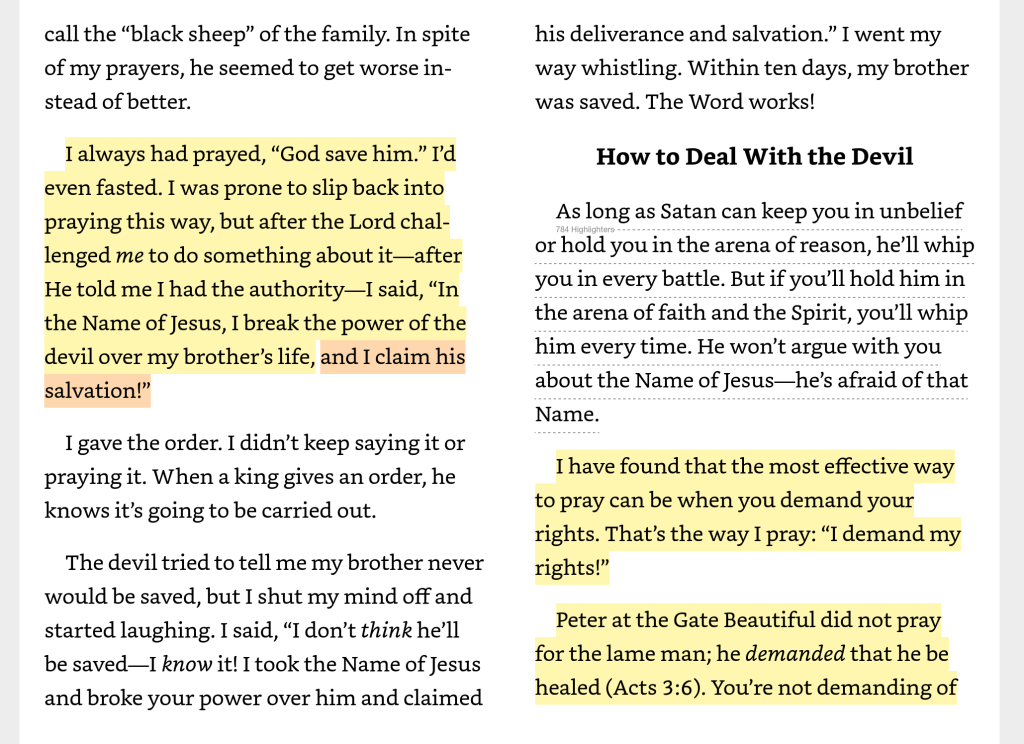
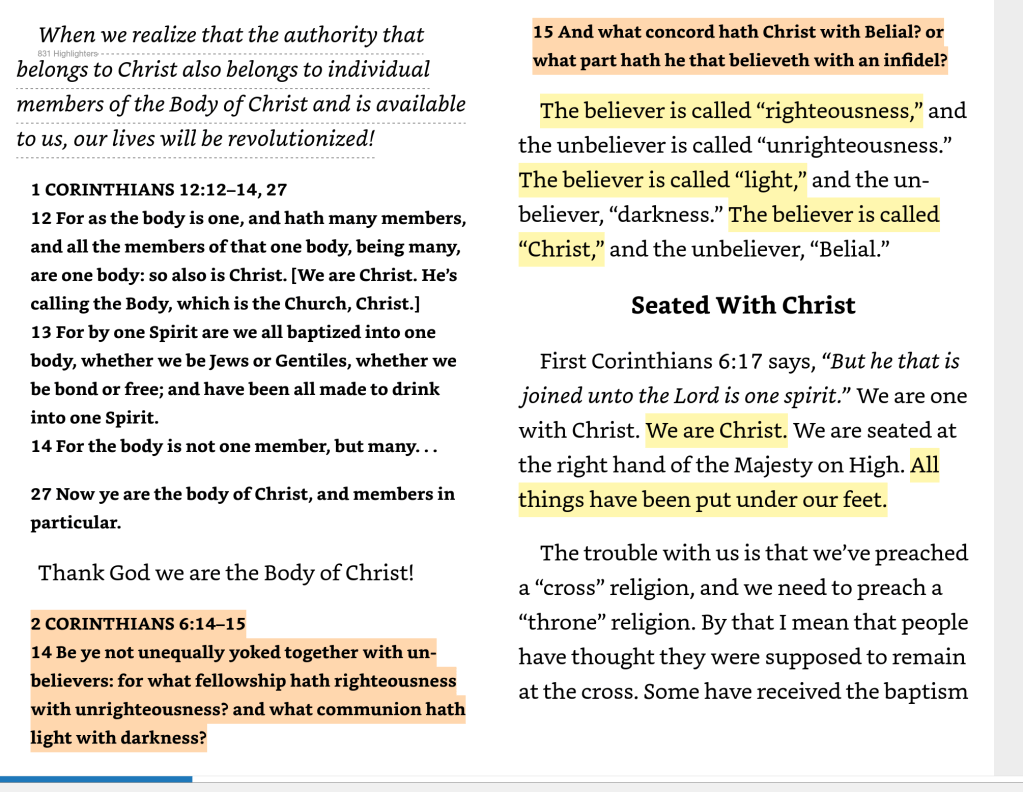
Here’s the next 3 screenshots of Hagin’s book:
He writes “if the church ever gets the revelation that we are the body of Christ, we’ll rise up and do the works of Christ.” First of all, When the Bible talks of the believer being the body of Christ, it is speaking figuratively. Christ called himself “the door” but he didn’t swing on hinges. He called himself the “bread of life” but he didn’t let his flesh get eaten by people. He called himself “The Good Shepherd” but he didn’t demand that his followers get down on all 4’s and eat grass and say “baaaa”. There is figurative language throughout the Old and New Testament, and Hagin seems oblivious to this. The body of Christ is simply “a group of followers of Christ”. So, everything that was conferred upon Christ is not directly conferred upon the followers of Christ. Christ was a martyr, and not every Christian is called to be a martyr. Christ said of his life in John 10:18 “No one has taken it away from Me, but I lay it down on My own. I have authority to lay it down, and I have authority to take it back. This commandment I received from My Father.” We as Christians need to be submitted to God and submitted to his authority and not be committed to the idea of wielding our “authority” around in the way Hagin advises. Under Christ’s authority is the safest place to be. And not assuming more than that.
There are many things Christ did that the believer is not called to do, such as travel to each of the exact cities Jesus visited, and to have the exact conversations Jesus had directly quoted from the Bible. We need to be wary of Hagin’s idea that “…the authority that belongs to Christ also belongs to individual members of the body of Christ and is available to us….” and that the authority is at the believer’s disposal. There were many things that Christ did alone as Messiah that only needed to be done by HIM. Things like His dying on the cross, things like he being whipped with a cat-o-nine tails, having to know every scripture with perfection that Christ did because He knows ALL things, plus to know the hearts of all people, and being able to answer prayer. But, because according to Hagin, we are not doing enough miracles, and not getting our lives revolutionized by that authority, because we just don’t know the things about spiritual authority like Hagin does because Hagin says that authority that belongs to Christ belongs to us, and that authority is at our disposal, Hagin says!
False Claim # 4, Hagin goes one more step and says “the believer is called righteousness”, “the believer is called light”, and “the believer is called “Christ””, and “all things have been put under our feet”( the believer’s feet). But the Bible says it is not the believer that maintains this authority because in Romans 16:20, it says “The God of peace will soon crush Satan under your feet. The grace of our Lord Jesus Christ be with you.” The Bible declares this responsibility is God’s, and that this is a free blessing of the crushing of Satan by God that God will do for the believer. Absent from the passage or even surrounding passages are any references that require the believer wielding the authority Hagin says belongs to the believer such as rebuking Satan or his demons, binding, or casting out Satan, or shouting at the devil. Hagin seems to point to these practices throughout his book as some main ways the believer is to exercise his/her authority. Hagin puts this job of doing spiritual warfare unto the shoulders of the believer. To contrast and compare, the New Testament talking about fighting the devil or demons simply tells the believer to submit to God, resist the devil and he will flee. And for the believer to stand for God with the armor of God on, and to stand up under temptation because we have been set free from the bondage of sin.
To continue with #4 which is Hagin’s thought that the believer is equal to Christ, notice how Hagin seems to enjoy putting the believer almost as a replacement for Christ. Pay attention to the highlighted areas of this next screenshot of the book:
Let’s think through this. It does not follow that believers are Christ, just because the Bible is talking about Christ in the text before in 2nd Corinthians 6:14-15. The Bible is COMPARING the believer TO CHRIST and the unbeliever to Belial.—We certainly are not pure light at this point. There are other substances in us, so how does it follow that we are pure Christ? We are not pure righteousness, because the righteousness of Christ is imputed to us, and counted in our favor even though we may have some actions which are not pure righteousness–we are in the sanctification process-not perfect yet! So how does it follow the believer is pure Christ?? Hagin’s reasoning doesn’t follow.
Are all things put under our feet? I think this will happen when the Lord takes us to heaven. Revelation 3:21 says “To the one who overcomes, I will grant the right to sit with Me on My throne, just as I overcame and sat down with My Father on His throne.” and in Matthew 19:28 it reads, “Truly I tell you, in the new world, you who have followed me will also sit on twelve thrones, judging the twelve tribes of Israel.” What is the timing of Revelation 3:21? When Christ says He will give the right for the believer to sit on his throne, He seems to be talking about what will happen to the believer in the life to come as a reward for following Christ. Matthew 19:28 was written specifically for the apostles.
The kind of victory that Hagin seems to talk about in his book “The Believer’s Authority” seems to say the Christian should never be sick, never be poor, and never be worried or anxious about anything, or having an occasional item stolen, and if you are, your not doing enough with your authority. He says the Christian must realize they are on the throne with Jesus right now. But sitting on the throne with Jesus seems to be in the future kingdom of God. Many of the troubles in life I have listed a few sentences ago are simply due to the fact that we live in a fallen world, and are not the direct result of the believer not using his “authority.” Jesus walked in perfect authority on the earth and the Bible says Judas stole finances from the ministry Jesus had complete authority over. So, is Hagin saying Jesus needed to use his authority more effectively because he was letting the enemy steal his finances? If so, Hagin is saying his personal use of authority is better than Jesus’ use of authority. Let’s look at the example Hagin uses of using “authority” to get his stolen pants back.
In the above screenshot, Hagin says he had 2 pairs of pants stolen and they were the only 2 pairs of pants good enough for him to preach in. Hagin gives this example of using his authority to be a template of what our lives as Christians should look like. Hagin says he was dealing with the spirit and not the person, but Hagin DID pray the person would be miserable so much that he would bring them back. He forgot to mention that! He attributes the success was because he told the evil spirit to stop stealing. Hagin seems to say Christians should never have any problems with being the victims of theft because Christians have authority over the demons that cause people to steal. Perhaps the Lord truly caused the person to bring back the 2 pairs of pants, but maybe God was answering Hagin’s prayer that the person would become miserable enough to bring them back, and it was because Hagin was dealing with the person, and might have not had anything to do with Hagin telling the evil spirit to “Stop the action”. The demon had already stopped the action by then anyhow. To be accurate, maybe Hagin should have told the demon to “reverse the action” if he was going to say it was his use of authority over the devil that got his pants back.
But if this is the template for Christian to follow and if it is to be the normal Christian life, there are no examples of this kind of freedom from trials for the Christian in the Bible after the apostles ministered. Even Jesus didn’t use some of these practices. We don’t see Paul demanding the devil to leave the people who were stoning him to stop, nor did Paul demand the demons holding him prisoner in Rome to stop, nor for the devil to “get his hands off his money”. We don’t see Jesus claiming Judas as his own follower or for people to truly become born again. He invited people “to come” to Him. They had to admit somewhere within that time that they were weary and heavy laden, because that is who Jesus called. No where in the New Testament (or OT) do the disciples take advantage of “claiming people for the kingdom” that Hagin speaks of in order to “do something about the salvation” of his brother.
First of all there is nothing wrong with praying “God save this person” and nothing wrong with fasting! Strangely, God seems to have “appointed” Hagin to “have an easier quick-fix” to his brother’s salvation! –To claim his brother’s salvation, and to demand your rights! –A whole lot can be said about this. Salvation BELONGS to God, and to whom God gives it. We are to ASK. There is nothing wrong with asking of fasting. Hagin makes these sound powerless. Quote “I was prone to slip back into praying this way…” but there was nothing wrong with praying “God save my brother” or to fast for their salvation. Nowhere in any place in the Bible does God tell the Minister to “claim” people for salvation. In Joshua’s day he said “as for me and my house, we will serve the Lord.” The word seems to show us that Joshua was saying he was going to lead a people that were going to serve the Lord, and that was the direction Joshua was going, and if they wanted to follow, they had to make a choice to conform to that way of life. Joshua wasn’t “creating salvation” by his words. He left up the actual choice of the people to God’s Sovereign work in their lives.
I believe many of our Christian spiritual battles are won with a good understanding of the subjects of doctrine represented in the pieces of the armor of God. (Salvation, righteousness, truth, peace, faith in God and in Christ, and a good understanding of the Word). But the New Testament does not emphasize that Christians should never be sick, have trouble with finances, or have other types of problems like fear, anxiety, or being robbed occasionally that Hagin singles out as resulting from not walking in “the authority of the believer”. What about the authority Paul walked in? Paul could heal people and rebuke demons and command people to be made well, but why didn’t he command the evil spirits that controlled the man who was involved in sexual immorality in 1 Corinthians 5:1-11 who had sexual relations with his father’s wife to stop this action? I am not saying we never need to resist the devil, but by Hagin’s example to tell the demon which caused the person to steal to “stop this action” Hagin is telling us that commanding demons seems to be the sole RIGHT WAY to find victory or to use our authority as believers. But is this truly how believers should use their authority? Or is it a better idea to ask the Lord to touch their heart and give them a change of heart? Paul recommended the people of Corinth deal in love and forgiveness with the person in 1 Corinthians 5.
I believe we should be responsible and faithful as Christians on the earth, fulfilling our calling and walking in as much submission to Christ and in as much victory as we can by grace through faith. I am not opposed to miracles, but we need to seek them only in a Biblical way. What is the picture of the Christian’s authority? I believe we still need to look to Christ, instead of trying to directly “do warfare against the devil” because we think we have the authority of Christ’s throne! Do we yell at demons when we are sick, because we think a Christian “doesn’t have to put up with that” or yell at demons when something difficult is happening to us like low finances because a Christian “doesn’t have to put up with that? Why do we not see examples of the disciples yelling at the devil when hardship came their way?
We all as Christians have proof individually that we are not in possession of the full authority of Christ’s throne because we sometimes get irritated if our car stalls out! We all have days when we have a backache or a headache! We have other aches and pains and colds and viruses! Have you had any vegetables that you had to clean out of your fridge in the last week because they got old and spoiled? Then, guess what!? All things have NOT been put under our feet. This belongs only to Jesus who reigns now in heaven. It is much more than just demons and devils that are put under Jesus’s feet! It is still possible that the God of peace could soon crush Satan underneath the feet of the believer whenever God may want to do that. But when God puts Satan under our feet, there is more that is under the feet of Christ when it says “all things are under Christ’s feet”. Satan is not ALL things! All things have been put under Christ’s feet in heaven. But there are things under Christ’s feet, simply because He is God, and He reigns in heaven and he overcame perfectly. So I don’t thing the goal of the Christian should be to seek perfect throne identity with Christ desiring that all things be placed under our feet as believers, except to submit to following Christ, and to be responsible with all the responsibilities he has entrusted to us, but in a Biblical way.
Christians are LIKE Christ but we ARE NOT Christ! We are not the Sovereign Creator. People don’t know how to make the earth turn on its axis. We don’t know how to make the clouds pour out rain. We don’t know how to put all the molecules in the right position for produce to grow and feed nations full of people. Or give life in the womb. God ALONE does, just to name a few things God can do that his people cannot do. So, all things have been placed under Jesus feet, the Lord of all creation. We are mere creatures. The authority Christians have been given to exercise on earth fits the role of people who are redeemed, We have a lesser authority than the perfect Son of God, Christians are saved from sin, who walk in a deep love for the Lord and worship Him in Spirit and Truth are those who STILL need a Savior who will operate in his distributed authority as an act of grace in our lives, because God is a good God. At the right time He Himself will soon Crush Satan underneath our feet.
The last point under the Seated With Christ heading, is that Hagin says “We are Christ”. Again, see the highlighted areas:
This friends, is demoting Christ, and elevating man…So much so that we are equal to one another. Hagin could have said “we are like Christ, or we are little Christs, (Christians) or we are united with Christ, or we belong to Christ.” The truth is Christians STILL NEED CHRIST and are dependent on Him. But to say we ARE Christ is borderline blasphemy. Hagin says this is why we have all the authority of Christ’s THRONE.
To wrap it up, Hagin has a lot of really bad false teaching and we need to mark and avoid him! While we do have some authority like the authority to become the children of God, and to submit to God, live for God, resist the devil, and he will flee, and the authority to stand against the devil and his temptations, we DO NOT HAVE ALL the authority of Christ’s throne to use at our disposal on earth is because people on the earth may only know bits and pieces of God’s will.
The Bible says we know only in part (1 Corinthians 13:9) so why would a responsible trustworthy God give the unlimited authority of Christ’s throne to his fallible children to carry out any kind of miracle they feel like doing or give them unlimited power to get each and every one of our prayers answered, to get every single sick person healed by commanding them to be healed exactly the way we want them to see this happen if we only knew bits and pieces of God’s will? If fallible people were in charge of the power of God we would leave gaping holes in the answers to prayer that should come forth, because God answers prayers in huge ways that have ripple effects, and God can see everything, and can answer everything, knows everything about everyone, and God is not selfish, and Christians sometimes struggle with that. The result would be a lot of things other than God’s will or we’d get possibly many answers falling short of God’s will that would be done on a regular basis at this point in history.
We still need a Savior–the Lord Jesus Christ! If you are like me and have put your trust in Jesus Christ to save you, we still need to practice putting off the sinful nature. This is only possible because Jesus Christ died on the cross, and put sin to death. Christ also was raised from the dead and ascended into heaven. Christ is our perfect example, and we are to continue following Him. Compared to Christ we are sinful but Christ has no sin and as God He is all-knowing and answers prayer perfectly, with his divine goodness. Born again people are told, to pray, or ASK and let our requests be made known to God. We don’t have the authority to command healing to come, or to command our prayers to come to pass. We submit to God and ASK. He alone has full authority to cause his will to come to pass and answer us because that is what His throne represents.
I hope this has been helpful. If you enjoyed it, please subscribe to this blog, and like it to let others know about it. And keep your eyes on Jesus and keep growing in the word! LG
Many Word of Faith teachers such as Kenneth Hagin, Copeland, and countless others in today’s Name It and Claim It and New Apostolic Reformation Movements say that it was Adam who forfeited the title deed of the earth to Satan after he sinned. The reason this is impossible is because Adam was never given the title deed of the earth by God to begin with. God gave Adam RESPONSIBILITY over the earth, but Adam never OWNED the earth. There was no exchange of a title deed involved. There was no verbal word from God ever telling Adam “Adam, I am making you now the owner of the earth.”
God promised Abraham and his descendants the property of Israel in Genesis 15:7. How? GOD STILL OWNED the earth at that time as he does today. Even after Adam sinned and Abraham came along God still had full dominion and ownership of the earth. It is a logical fallacy to think that Satan was in possession of the earth after Adam sinned in Genesis 3, and hundreds of years later when Abraham comes along, that God could make a promise to give the land of Israel to Abraham if Satan had the title deed to the earth.
Genesis 15:7, and 18-21 reads “And He said to him, “I am the Lord who brought you out of Ur of the Chaldeans, to give you this land to possess it.”… “On that day the Lord made a covenant with Abram, saying to your descendants I have given this land, from the river of Egypt as far as the great river, the river Euphrates: 19 the land of the Kenite, the Kenizzite, the Kadmonite, 20 the Hittite, the Perizzite, the Rephaim, 21 the Amorite, the Canaanite, the Girgashite, and the Jebusite.”
Regarding Adam’s stewardship and the responsibility God gave him, Genesis 1:26 reads, “And God said, Let us make man in our image, after our likeness: and let them have dominion over the fish of the sea, and over the fowl of the air, and over the cattle, and over all the earth, and over every creeping thing that creepeth upon the earth.” To have dominion over the plant and animal kingdoms and over all the earth is not the same thing as owning the entire earth. The Greek word in Genesis 1:26 for the word dominion, has the meaning of “to have dominion, rule, dominate”. A king can do it, or a teacher in a classroom can do it. There are different levels of dominion. God did not give Adam or Eve dominion over people. God still had ultimate dominion over all the earth, plant, and animal kingdoms and over the entire human race because when Adam and Eve sinned in Genesis 3, why did Adam and Eve hide from God?
If Adam was in charge of the earth more than God, couldn’t Adam just block God from the earth? NO, because God had full access to the earth even as He does today. Adam and Eve were subject to God. All of us are subject to God today. When Adam and Eve sinned, they knew they messed up, and they had to answer to God for their sin, and their stewardship and that is why they hid themselves. Genesis 3:8-9 says “Now they heard the sound of the Lord God walking in the garden in the cool of the day, and the man and his wife hid themselves from the presence of the Lord God among the trees of the garden. 9 Then the Lord God called to the man, and said to him, “Where are you?” 10 He said, “I heard the sound of You in the garden, and I was afraid because I was naked; so I hid myself.”
Was there a title deed and did it transfer owners or something else? A title deed of the earth would mean a person to whom it belonged would be recognized or declared as the owner of the earth or possessor of the earth. God declares himself possessor of the earth in Genesis 14:19. “Genesis 14:19 states. “And he blessed him and said, “Blessed be Abram of the Most High God, possessor of heaven and earth;…” According to Biblehub.com, it gives us the Brown-Driver-Briggs Hebrew Lexicon. This speaks of the word possessor in Gen 14:19 of God as the “possessor …as originating, creating…” heaven and earth, which is very straightforward. God called himself the possessor of the earth even after Adam’s sin. So, the “title deed” or ownership or rulership of the earth did not go to Satan.
Now concerning the scripture that speaks of Satan as God of this world, we get 2 Corinthians 4:4. In the King James Version it reads, “in whose case the god of this world has blinded the minds of the unbelieving so that they will not see the light of the gospel of the glory of Christ, who is the image of God.” That word “world” in the Greek is “aiōnos”. It means “a space of time, an age”. “…an age, a cycle (of time), especially of the present age as contrasted with the future age…”. So, 2nd Corinthians 4:4 in the Greek means Satan is “god” of this age. He is not God of this world, but simply of “this space of time or age”.
God is possessor or heaven and earth, (Gen 14:19) and over the Kingdom of Light (1 John 1:5, Rev. 22:5, Acts 26:18, Eph. 5:8, Col 1:13, Rev 21:23).
1 John 1:5 This is the message we have heard from Him and announce to you, that God is Light, and in Him there is no darkness at all.
Rev 22:5 And there shall be no night there; and they need no candle, neither light of the sun; for the Lord God giveth them light: and they shall reign for ever and ever.
Acts 26:18 To open their eyes, and to turn them from darkness to light, and from the power of Satan unto God, that they may receive forgiveness of sins, and inheritance among them which are sanctified by faith that is in me.
Eph 5:8 For ye were sometimes darkness, but now are ye light in the Lord: walk as children of light:
Col 1:13 Who hath delivered us from the power of darkness, and hath translated us into the kingdom of his dear Son:
Rev 21:23 And the city had no need of the sun, neither of the moon, to shine in it: for the glory of God did lighten it, and the Lamb is the light thereof.
Furthermore, if you need evidence that God is in control in heaven and on earth, here are three additional scriptures to stand for themselves:
Psalm 115:3 But our God is in the heavens; He does whatever He pleases.
Psalm 135:6 Whatever the Lord pleases, He does, in heaven and on earth, in the seas and in all the ocean depths.
John 1:5 The light shines in the darkness, and the darkness has not overcome it.
Satan is over the kingdom of darkness, but God’s kingdom is over Satan’s Kingdom, because God kicked Satan out of heaven and He triumphed over Satan through the cross of Christ when Christ paid for the sins of the world to be forgiven. It will soon come to pass what is written in Revelation 11:15, which reads, “Then the seventh angel sounded; and there were loud voices in heaven, saying, “The kingdom of the world has become the kingdom of our Lord and of His Christ; and He will reign forever and ever.” The word “world” in the Greek means “the world, universe; worldly affairs; the inhabitants of the world…”. Because He will reign forever and ever, Satan’s time of rule of this age will soon be over. LG
The Faith is from God, and not of the self. There is no way a man or woman, boy or girl can save themselves. Salvation only comes from God. Therefore, we must receive saving faith under God’s terms, and it must be the kind of faith God approves for us and accepts from us for it to save us from our sins.
Saving faith understands the need all mankind has for being saved from their own personal sin. And that personal sin of yours and mine has offended The perfectly, pure, innocent, holy and without blemish Jesus of Nazareth, The Lord of Glory.
The faith is active, alive, and fed by God—It is fed primarily by the Word of God itself-The Bible. Dead faith is in danger of being withered and burned up, along with the person possessing the dead faith.
Will the sermon you hear inspire faith? If the message brings glory to Jesus, it will focus on his qualities and characteristics. The focus of the message will not just be about blessings, health and prosperity. It will be balanced and talk about both the free gift of salvation from God, but also the way God changes us in our hearts, disciplines us when we do wrong, trains us in righteousness, and challenges our faith to grow according to God’s plan revealed in His word. Some of His plan involves some measure of suffering for each of us.
It recognizes Jesus as Lord, and Him Alone as Lord (in unity with the Father and The Holy Spirit).
It understands the difference between what it means to be affected by the Lordship of Jesus rather than just thinking you’re saved because Jesus is “the Savior”.
It wants to understand the requirements of God. The 10 commandments were called the 10 commandments, not the 10 suggestions. And we can say there is much instruction in God’s word that is not a suggestion but are commandments other than the 10 commandments.
It understands that there is no salvation without repentance.
True saving faith brings gladness and thanksgiving to the heart and mind, and inspires our true praise and worship of God, even as we go through times of difficulty and through the all too common pains of life.
With it we bear good fruit for the kingdom of God that will last through the suffering, and difficulties, and hardships we may go through in this life.
These are some basic traits that come to my mind. Leave a comment if you can think of any I may have missed. LG



 groenintheword.blog