Kenneth Hagin the popular televangelist from the 1950’s to the 1990’s wrote several influential false teaching books, and we will continue looking at some of these false teachings. Romans 16:17 KJV says “Now I beseech you, brethren, mark them which cause divisions and offences contrary to the doctrine which ye have learned; and avoid them.”, so, we are going to mark them today in order to avoid them.
We will look at 4 of the false claims Hagin makes in Chapter 3 of “The Believer’s Authority” with some screenshots of the Kindle version.
They are:
False Claim # 1, Hagin says believers sit on the throne of Christ in heaven with him, during his/her life on earth, before the end of their life and before they are taken to heaven.
False Claim # 2 Believers share the equal authority of Christ’s throne with Him.
False Claim # 3 The authority of Christ’s throne is at the believer’s disposal and we should use it.
And False Claim # 4, Hagin goes one more step and says because all things are under Christ’s feet who is on the throne/ and believers ARE Christ and on His throne with Him/all things have been put under the believer’s feet
1. Hagin says believers sit on the throne of Christ in heaven with him in their life on earth. Revelation 3:21 appears to be a reward for Christians at the END OF THEIR LIFE. We do not do this during our earthly life –we are merely seated in the heavenly realms with Him. There are perhaps vast multitudes of seats in heaven—we could imagine there are enough seats in heaven for each of God’s people to have at least one place to sit. Daniel 7:27 reads “But the kingdom and the dominion and the greatness of the kingdoms under all the heavens will be given to the people, to the saints of the Most High. His kingdom is an eternal kingdom, and all dominions will worship and obey him.” The timing when the kingdom, and dominion and the greatness of the kingdom will be given to the saints of the most high seems to be when all dominions will worship and obey him–as it says in the verse–in the age to come. Not everyone in all dominions are serving him at this time, worshipping him, and obeying him now–so we know the timing of this is the future time, most likely the age to come.
Here’s the screenshot from Hagin’s book, “The Believer’s Authority, Chapter 3, entitled “Seated With Christ” Pay attention to the yellow highlighting:

Hagin says we are sharing Christ’s throne because we are seated on Christ’s throne. However the Bible says Christians ARE seated with Christ in the heavenly realms, but not on His THRONE! When we on earth are seated WITH someone in a restaurant, we are usually at the same table as they are–but not ON THEIR CHAIR. When we are seated WITH someone an a sofa, we are on the same sofa, but NOT ON THE SAME CUSHION.
So Hagin says that because we sit together with Christ, we must of course sit on Christ’s throne with Him! But the logic doesn’t follow!
Ephesians 2:6 says believers have been seated in the heavenly realms with Christ, but a realm is not the throne of Christ! If God wanted to say that believers are seated on the throne of Christ with Him He could have said that in the word, because God knows the difference between the word “realm” and the word “throne”. But the word says we are in the heavenly realms WITH Christ. And a heavenly PLACE or heavenly REALM and Christ’s THRONE are NOT THE SAME THING are they?
False Claim # 2 Believers share the authority of Christ’s throne with Him
But the Bible says it is GOD ALONE who possesses the full authority of his throne. As Christians we have a MEASURE of Christ’s authority. I believe Christians are charged to be faithful in this life in living for Christ, which if we are faithful with little we will become faithful with much. But only Christ can rightly manage his throne authority in a perfectly Godly way 100% of the time.
Here is another screenshot of Hagin’s book from Chapter 3 showing another quote about who Hagin believes gets to possess Christ’s full throne authority:

So, Colossians 1:13 is true which reads (God/Christ) “who did rescue us out of the authority of the darkness, and did translate [us] into the reign of the Son of His love” and, this authority was exercised by God. Although Hagin believes the above screenshot is true, that believers share the full authority of Christ’s throne because what was conferred upon the head is automatically conferred upon the body. But our physical bodies cannot operate without the head-the same is true for us spiritually–the believer cannot operate the authority given to us by God without Christ. The truth is believers DO NOT SHARE all the authority of Jesus’ throne—because we don’t fully know how the throne of Christ operates with full authority, so we have only some authority. We have been given authority to become children of God, to submit to God and resist the devil, and he will flee, and authority to not to have to give the devil a foothold. Other types of authority mentioned in the New Testament include the believer having authority over his/her body in a marriage relationship which is not really relevant to the study of “The Believer’s Authority” and other kinds of authority in relationships such as “building people up and not tearing them down”.
Logically speaking, Christ has also given us the necessary measure of authority to fulfill our calling, but we still need God’s help and direction and power with this, often on a daily basis and not everyone has an equal calling or equal gifting. Christians today do not have the same calling as any of the original 12 apostles did, so, logically, because we don’t have equal callings, we don’t have equal power or authority on the earth as the original 12 apostles did. We therefore certainly do not have the same power, authority and dominion as Christ! (this argument is based on looking at calling/ministry alone, comparing the callings of modern day Christians to Jesus’s ministry, aside from the obvious fact that He is God, and we are not!) There has got to be countless things Christ orchestrates from His Throne that the Christian has no knowledge of, even on a day to day basis, and that we have no direct participation in. So, to say we share the full authority of the throne of Christ is definitely Not True!
False Claim # 3 The authority of Christ’s throne is at the believer’s disposal (because we are seated on Christ’s throne) and we should learn how to use it to be victorious:
Here’s the next 3 screenshots of Hagin’s book:


He writes “if the church ever gets the revelation that we are the body of Christ, we’ll rise up and do the works of Christ.” First of all, When the Bible talks of the believer being the body of Christ, it is speaking figuratively. Christ called himself “the door” but he didn’t swing on hinges. He called himself the “bread of life” but he didn’t let his flesh get eaten by people. He called himself “The Good Shepherd” but he didn’t demand that his followers get down on all 4’s and eat grass and say “baaaa”. There is figurative language throughout the Old and New Testament, and Hagin seems oblivious to this. The body of Christ is simply “a group of followers of Christ”. So, everything that was conferred upon Christ is not directly conferred upon the followers of Christ. Christ was a martyr, and not every Christian is called to be a martyr. Christ said of his life in John 10:18 “No one has taken it away from Me, but I lay it down on My own. I have authority to lay it down, and I have authority to take it back. This commandment I received from My Father.” We as Christians need to be submitted to God and submitted to his authority and not be committed to the idea of wielding our “authority” around in the way Hagin advises. Under Christ’s authority is the safest place to be. And not assuming more than that.
There are many things Christ did that the believer is not called to do, such as travel to each of the exact cities Jesus visited, and to have the exact conversations Jesus had directly quoted from the Bible. We need to be wary of Hagin’s idea that “…the authority that belongs to Christ also belongs to individual members of the body of Christ and is available to us….” and that the authority is at the believer’s disposal. There were many things that Christ did alone as Messiah that only needed to be done by HIM. Things like His dying on the cross, things like he being whipped with a cat-o-nine tails, having to know every scripture with perfection that Christ did because He knows ALL things, plus to know the hearts of all people, and being able to answer prayer. But, because according to Hagin, we are not doing enough miracles, and not getting our lives revolutionized by that authority, because we just don’t know the things about spiritual authority like Hagin does because Hagin says that authority that belongs to Christ belongs to us, and that authority is at our disposal, Hagin says!
False Claim # 4, Hagin goes one more step and says “the believer is called righteousness”, “the believer is called light”, and “the believer is called “Christ””, and “all things have been put under our feet”( the believer’s feet). But the Bible says it is not the believer that maintains this authority because in Romans 16:20, it says “The God of peace will soon crush Satan under your feet. The grace of our Lord Jesus Christ be with you.” The Bible declares this responsibility is God’s, and that this is a free blessing of the crushing of Satan by God that God will do for the believer. Absent from the passage or even surrounding passages are any references that require the believer wielding the authority Hagin says belongs to the believer such as rebuking Satan or his demons, binding, or casting out Satan, or shouting at the devil. Hagin seems to point to these practices throughout his book as some main ways the believer is to exercise his/her authority. Hagin puts this job of doing spiritual warfare unto the shoulders of the believer. To contrast and compare, the New Testament talking about fighting the devil or demons simply tells the believer to submit to God, resist the devil and he will flee. And for the believer to stand for God with the armor of God on, and to stand up under temptation because we have been set free from the bondage of sin.
To continue with #4 which is Hagin’s thought that the believer is equal to Christ, notice how Hagin seems to enjoy putting the believer almost as a replacement for Christ. Pay attention to the highlighted areas of this next screenshot of the book:

Let’s think through this. It does not follow that believers are Christ, just because the Bible is talking about Christ in the text before in 2nd Corinthians 6:14-15. The Bible is COMPARING the believer TO CHRIST and the unbeliever to Belial.—We certainly are not pure light at this point. There are other substances in us, so how does it follow that we are pure Christ? We are not pure righteousness, because the righteousness of Christ is imputed to us, and counted in our favor even though we may have some actions which are not pure righteousness–we are in the sanctification process-not perfect yet! So how does it follow the believer is pure Christ?? Hagin’s reasoning doesn’t follow.
Are all things put under our feet? I think this will happen when the Lord takes us to heaven. Revelation 3:21 says “To the one who overcomes, I will grant the right to sit with Me on My throne, just as I overcame and sat down with My Father on His throne.” and in Matthew 19:28 it reads, “Truly I tell you, in the new world, you who have followed me will also sit on twelve thrones, judging the twelve tribes of Israel.” What is the timing of Revelation 3:21? When Christ says He will give the right for the believer to sit on his throne, He seems to be talking about what will happen to the believer in the life to come as a reward for following Christ. Matthew 19:28 was written specifically for the apostles.
The kind of victory that Hagin seems to talk about in his book “The Believer’s Authority” seems to say the Christian should never be sick, never be poor, and never be worried or anxious about anything, or having an occasional item stolen, and if you are, your not doing enough with your authority. He says the Christian must realize they are on the throne with Jesus right now. But sitting on the throne with Jesus seems to be in the future kingdom of God. Many of the troubles in life I have listed a few sentences ago are simply due to the fact that we live in a fallen world, and are not the direct result of the believer not using his “authority.” Jesus walked in perfect authority on the earth and the Bible says Judas stole finances from the ministry Jesus had complete authority over. So, is Hagin saying Jesus needed to use his authority more effectively because he was letting the enemy steal his finances? If so, Hagin is saying his personal use of authority is better than Jesus’ use of authority. Let’s look at the example Hagin uses of using “authority” to get his stolen pants back.

In the above screenshot, Hagin says he had 2 pairs of pants stolen and they were the only 2 pairs of pants good enough for him to preach in. Hagin gives this example of using his authority to be a template of what our lives as Christians should look like. Hagin says he was dealing with the spirit and not the person, but Hagin DID pray the person would be miserable so much that he would bring them back. He forgot to mention that! He attributes the success was because he told the evil spirit to stop stealing. Hagin seems to say Christians should never have any problems with being the victims of theft because Christians have authority over the demons that cause people to steal. Perhaps the Lord truly caused the person to bring back the 2 pairs of pants, but maybe God was answering Hagin’s prayer that the person would become miserable enough to bring them back, and it was because Hagin was dealing with the person, and might have not had anything to do with Hagin telling the evil spirit to “Stop the action”. The demon had already stopped the action by then anyhow. To be accurate, maybe Hagin should have told the demon to “reverse the action” if he was going to say it was his use of authority over the devil that got his pants back.
But if this is the template for Christian to follow and if it is to be the normal Christian life, there are no examples of this kind of freedom from trials for the Christian in the Bible after the apostles ministered. Even Jesus didn’t use some of these practices. We don’t see Paul demanding the devil to leave the people who were stoning him to stop, nor did Paul demand the demons holding him prisoner in Rome to stop, nor for the devil to “get his hands off his money”. We don’t see Jesus claiming Judas as his own follower or for people to truly become born again. He invited people “to come” to Him. They had to admit somewhere within that time that they were weary and heavy laden, because that is who Jesus called. No where in the New Testament (or OT) do the disciples take advantage of “claiming people for the kingdom” that Hagin speaks of in order to “do something about the salvation” of his brother.
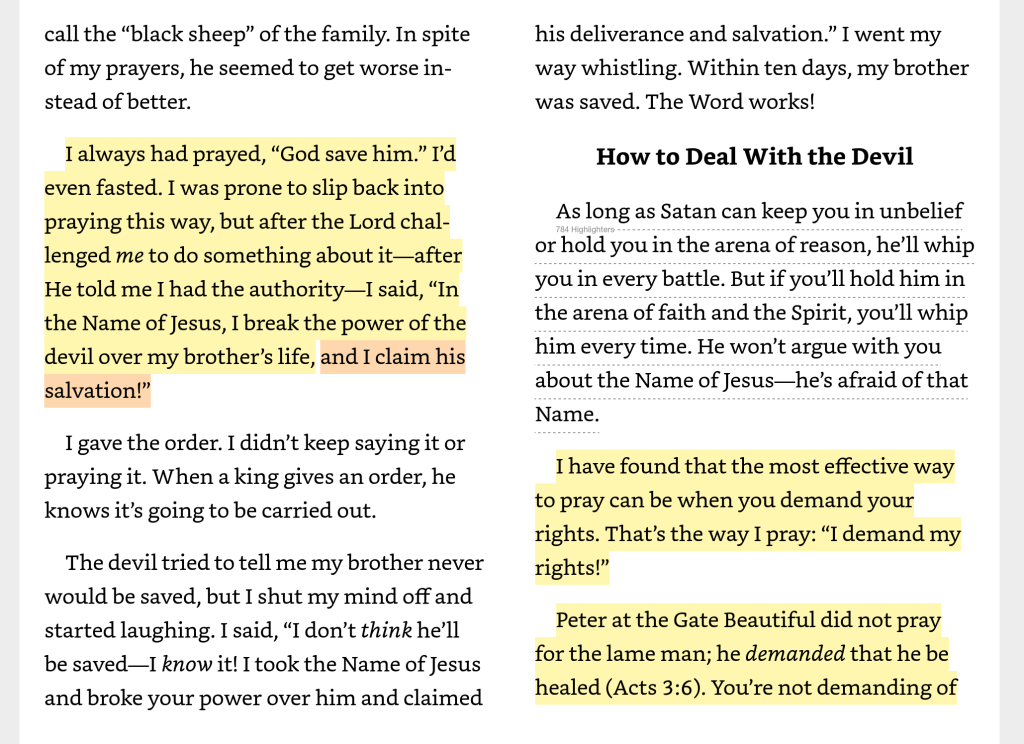
First of all there is nothing wrong with praying “God save this person” and nothing wrong with fasting! Strangely, God seems to have “appointed” Hagin to “have an easier quick-fix” to his brother’s salvation! –To claim his brother’s salvation, and to demand your rights! –A whole lot can be said about this. Salvation BELONGS to God, and to whom God gives it. We are to ASK. There is nothing wrong with asking of fasting. Hagin makes these sound powerless. Quote “I was prone to slip back into praying this way…” but there was nothing wrong with praying “God save my brother” or to fast for their salvation. Nowhere in any place in the Bible does God tell the Minister to “claim” people for salvation. In Joshua’s day he said “as for me and my house, we will serve the Lord.” The word seems to show us that Joshua was saying he was going to lead a people that were going to serve the Lord, and that was the direction Joshua was going, and if they wanted to follow, they had to make a choice to conform to that way of life. Joshua wasn’t “creating salvation” by his words. He left up the actual choice of the people to God’s Sovereign work in their lives.
I believe many of our Christian spiritual battles are won with a good understanding of the subjects of doctrine represented in the pieces of the armor of God. (Salvation, righteousness, truth, peace, faith in God and in Christ, and a good understanding of the Word). But the New Testament does not emphasize that Christians should never be sick, have trouble with finances, or have other types of problems like fear, anxiety, or being robbed occasionally that Hagin singles out as resulting from not walking in “the authority of the believer”. What about the authority Paul walked in? Paul could heal people and rebuke demons and command people to be made well, but why didn’t he command the evil spirits that controlled the man who was involved in sexual immorality in 1 Corinthians 5:1-11 who had sexual relations with his father’s wife to stop this action? I am not saying we never need to resist the devil, but by Hagin’s example to tell the demon which caused the person to steal to “stop this action” Hagin is telling us that commanding demons seems to be the sole RIGHT WAY to find victory or to use our authority as believers. But is this truly how believers should use their authority? Or is it a better idea to ask the Lord to touch their heart and give them a change of heart? Paul recommended the people of Corinth deal in love and forgiveness with the person in 1 Corinthians 5.
I believe we should be responsible and faithful as Christians on the earth, fulfilling our calling and walking in as much submission to Christ and in as much victory as we can by grace through faith. I am not opposed to miracles, but we need to seek them only in a Biblical way. What is the picture of the Christian’s authority? I believe we still need to look to Christ, instead of trying to directly “do warfare against the devil” because we think we have the authority of Christ’s throne! Do we yell at demons when we are sick, because we think a Christian “doesn’t have to put up with that” or yell at demons when something difficult is happening to us like low finances because a Christian “doesn’t have to put up with that? Why do we not see examples of the disciples yelling at the devil when hardship came their way?
We all as Christians have proof individually that we are not in possession of the full authority of Christ’s throne because we sometimes get irritated if our car stalls out! We all have days when we have a backache or a headache! We have other aches and pains and colds and viruses! Have you had any vegetables that you had to clean out of your fridge in the last week because they got old and spoiled? Then, guess what!? All things have NOT been put under our feet. This belongs only to Jesus who reigns now in heaven. It is much more than just demons and devils that are put under Jesus’s feet! It is still possible that the God of peace could soon crush Satan underneath the feet of the believer whenever God may want to do that. But when God puts Satan under our feet, there is more that is under the feet of Christ when it says “all things are under Christ’s feet”. Satan is not ALL things! All things have been put under Christ’s feet in heaven. But there are things under Christ’s feet, simply because He is God, and He reigns in heaven and he overcame perfectly. So I don’t thing the goal of the Christian should be to seek perfect throne identity with Christ desiring that all things be placed under our feet as believers, except to submit to following Christ, and to be responsible with all the responsibilities he has entrusted to us, but in a Biblical way.
Christians are LIKE Christ but we ARE NOT Christ! We are not the Sovereign Creator. People don’t know how to make the earth turn on its axis. We don’t know how to make the clouds pour out rain. We don’t know how to put all the molecules in the right position for produce to grow and feed nations full of people. Or give life in the womb. God ALONE does, just to name a few things God can do that his people cannot do. So, all things have been placed under Jesus feet, the Lord of all creation. We are mere creatures. The authority Christians have been given to exercise on earth fits the role of people who are redeemed, We have a lesser authority than the perfect Son of God, Christians are saved from sin, who walk in a deep love for the Lord and worship Him in Spirit and Truth are those who STILL need a Savior who will operate in his distributed authority as an act of grace in our lives, because God is a good God. At the right time He Himself will soon Crush Satan underneath our feet.
The last point under the Seated With Christ heading, is that Hagin says “We are Christ”. Again, see the highlighted areas:
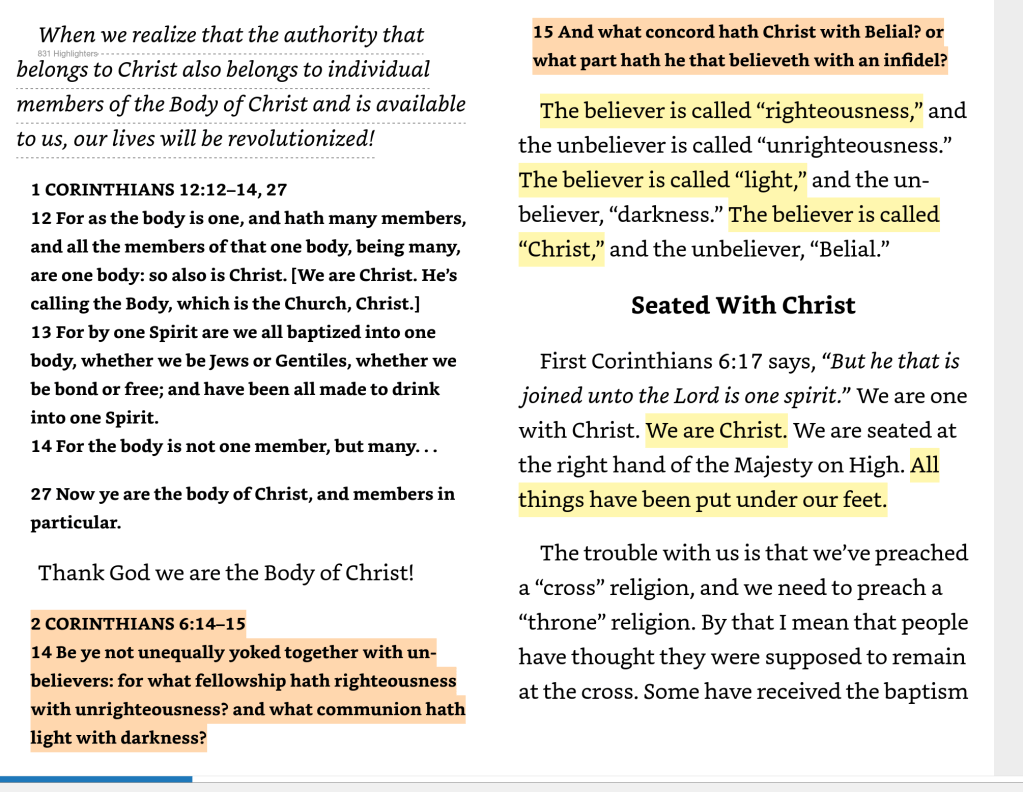
This friends, is demoting Christ, and elevating man…So much so that we are equal to one another. Hagin could have said “we are like Christ, or we are little Christs, (Christians) or we are united with Christ, or we belong to Christ.” The truth is Christians STILL NEED CHRIST and are dependent on Him. But to say we ARE Christ is borderline blasphemy. Hagin says this is why we have all the authority of Christ’s THRONE.
To wrap it up, Hagin has a lot of really bad false teaching and we need to mark and avoid him! While we do have some authority like the authority to become the children of God, and to submit to God, live for God, resist the devil, and he will flee, and the authority to stand against the devil and his temptations, we DO NOT HAVE ALL the authority of Christ’s throne to use at our disposal on earth is because people on the earth may only know bits and pieces of God’s will.
The Bible says we know only in part (1 Corinthians 13:9) so why would a responsible trustworthy God give the unlimited authority of Christ’s throne to his fallible children to carry out any kind of miracle they feel like doing or give them unlimited power to get each and every one of our prayers answered, to get every single sick person healed by commanding them to be healed exactly the way we want them to see this happen if we only knew bits and pieces of God’s will? If fallible people were in charge of the power of God we would leave gaping holes in the answers to prayer that should come forth, because God answers prayers in huge ways that have ripple effects, and God can see everything, and can answer everything, knows everything about everyone, and God is not selfish, and Christians sometimes struggle with that. The result would be a lot of things other than God’s will or we’d get possibly many answers falling short of God’s will that would be done on a regular basis at this point in history.
We still need a Savior–the Lord Jesus Christ! If you are like me and have put your trust in Jesus Christ to save you, we still need to practice putting off the sinful nature. This is only possible because Jesus Christ died on the cross, and put sin to death. Christ also was raised from the dead and ascended into heaven. Christ is our perfect example, and we are to continue following Him. Compared to Christ we are sinful but Christ has no sin and as God He is all-knowing and answers prayer perfectly, with his divine goodness. Born again people are told, to pray, or ASK and let our requests be made known to God. We don’t have the authority to command healing to come, or to command our prayers to come to pass. We submit to God and ASK. He alone has full authority to cause his will to come to pass and answer us because that is what His throne represents.
I hope this has been helpful. If you enjoyed it, please subscribe to this blog, and like it to let others know about it. And keep your eyes on Jesus and keep growing in the word! LG
 groenintheword.blog